Landau distribution
Probability distribution
From Wikipedia, the free encyclopedia
In probability theory, the Landau distribution[1] is a probability distribution named after Lev Landau.


| Landau distribution | |||
|---|---|---|---|
|
Probability density function | |||
| Parameters | — location parameter | ||
| Support | |||
| Mean | Undefined | ||
| Variance | Undefined | ||
| MGF | Undefined | ||
| CF | |||

Because of the distribution's "fat" tail, the moments of the distribution, such as mean or variance, are undefined. The distribution is a particular case of stable distribution.
Definition
The probability density function, as written originally by Landau, is defined by the complex integral:

where a is an arbitrary positive real number, meaning that the integration path can be any parallel to the imaginary axis, intersecting the real positive semi-axis, and refers to the natural logarithm. In other words, it is the Laplace transform of the function .


The following real integral is equivalent to the above:

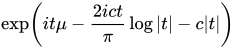
The full family of Landau distributions is obtained by extending the original distribution to a location-scale family of stable distributions with parameters and ,[2] with characteristic function:[3]


where and , which yields a density function:

Taking and we get the original form of above.


Properties


- Translation: If then .
- Scaling: If then .
- Sum: If and then .






These properties can all be derived from the characteristic function. Together they imply that the Landau distributions are closed under affine transformations.
Approximations
In the "standard" case and , the pdf can be approximated[4] using Lindhard theory which says:


where is Euler's constant.

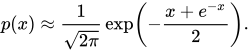
A similar approximation [5] of for and is:


Applications
In nuclear and particle physics, the Landau distribution appears as a probability that a fast particle with a given initial energy will lose a given energy after passing the layer of matter with given thickness.[6]
Related distributions
- The Landau distribution is a stable distribution with stability parameter and skewness parameter both equal to 1.

