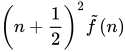
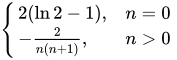
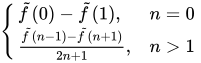
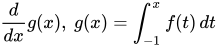
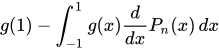
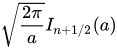
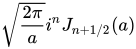
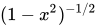
Legendre transform (integral transform) From Wikipedia, the free encyclopedia In mathematics, Legendre transform is an integral transform named after the mathematician Adrien-Marie Legendre, which uses Legendre polynomials P n ( x ) {\displaystyle P_{n}(x)} as kernels of the transform. Legendre transform is a special case of Jacobi transform. The Legendre transform of a function f ( x ) {\displaystyle f(x)} is[1][2][3] J n { f ( x ) } = f ~ ( n ) = ∫ − 1 1 P n ( x ) f ( x ) d x {\displaystyle {\mathcal {J}}_{n}\{f(x)\}={\tilde {f}}(n)=\int _{-1}^{1}P_{n}(x)\ f(x)\ dx} The inverse Legendre transform is given by J n − 1 { f ~ ( n ) } = f ( x ) = ∑ n = 0 ∞ 2 n + 1 2 f ~ ( n ) P n ( x ) {\displaystyle {\mathcal {J}}_{n}^{-1}\{{\tilde {f}}(n)\}=f(x)=\sum _{n=0}^{\infty }{\frac {2n+1}{2}}{\tilde {f}}(n)P_{n}(x)} Associated Legendre transform is defined as J n , m { f ( x ) } = f ~ ( n , m ) = ∫ − 1 1 ( 1 − x 2 ) − m / 2 P n m ( x ) f ( x ) d x {\displaystyle {\mathcal {J}}_{n,m}\{f(x)\}={\tilde {f}}(n,m)=\int _{-1}^{1}(1-x^{2})^{-m/2}P_{n}^{m}(x)\ f(x)\ dx} The inverse Legendre transform is given by J n , m − 1 { f ~ ( n , m ) } = f ( x ) = ∑ n = 0 ∞ 2 n + 1 2 ( n − m ) ! ( n + m ) ! f ~ ( n , m ) ( 1 − x 2 ) m / 2 P n m ( x ) {\displaystyle {\mathcal {J}}_{n,m}^{-1}\{{\tilde {f}}(n,m)\}=f(x)=\sum _{n=0}^{\infty }{\frac {2n+1}{2}}{\frac {(n-m)!}{(n+m)!}}{\tilde {f}}(n,m)(1-x^{2})^{m/2}P_{n}^{m}(x)} Some Legendre transform pairs f ( x ) {\displaystyle f(x)\,} f ~ ( n ) {\displaystyle {\tilde {f}}(n)\,} x n {\displaystyle x^{n}\,} 2 n + 1 ( n ! ) 2 ( 2 n + 1 ) ! {\displaystyle {\frac {2^{n+1}(n!)^{2}}{(2n+1)!}}} e a x {\displaystyle e^{ax}\,} 2 π a I n + 1 / 2 ( a ) {\displaystyle {\sqrt {\frac {2\pi }{a}}}I_{n+1/2}(a)} e i a x {\displaystyle e^{iax}\,} 2 π a i n J n + 1 / 2 ( a ) {\displaystyle {\sqrt {\frac {2\pi }{a}}}i^{n}J_{n+1/2}(a)} x f ( x ) {\displaystyle xf(x)\,} 1 2 n + 1 [ ( n + 1 ) f ~ ( n + 1 ) + n f ~ ( n − 1 ) ] {\displaystyle {\frac {1}{2n+1}}[(n+1){\tilde {f}}(n+1)+n{\tilde {f}}(n-1)]} ( 1 − x 2 ) − 1 / 2 {\displaystyle (1-x^{2})^{-1/2}\,} π P n 2 ( 0 ) {\displaystyle \pi P_{n}^{2}(0)} [ 2 ( a − x ) ] − 1 {\displaystyle [2(a-x)]^{-1}\,} Q n ( a ) {\displaystyle Q_{n}(a)} ( 1 − 2 a x + a 2 ) − 1 / 2 , | a | < 1 {\displaystyle (1-2ax+a^{2})^{-1/2},\ |a|<1\,} 2 a n ( 2 n + 1 ) − 1 {\displaystyle 2a^{n}(2n+1)^{-1}} ( 1 − 2 a x + a 2 ) − 3 / 2 , | a | < 1 {\displaystyle (1-2ax+a^{2})^{-3/2},\ |a|<1\,} 2 a n ( 1 − a 2 ) − 1 {\displaystyle 2a^{n}(1-a^{2})^{-1}} ∫ 0 a t b − 1 d t ( 1 − 2 x t + t 2 ) 1 / 2 , | a | < 1 b > 0 {\displaystyle \int _{0}^{a}{\frac {t^{b-1}\,dt}{(1-2xt+t^{2})^{1/2}}},\ |a|<1\ b>0\,} 2 a n + b ( 2 n + 1 ) ( n + b ) {\displaystyle {\frac {2a^{n+b}}{(2n+1)(n+b)}}} d d x [ ( 1 − x 2 ) d d x ] f ( x ) {\displaystyle {\frac {d}{dx}}\left[(1-x^{2}){\frac {d}{dx}}\right]f(x)\,} − n ( n + 1 ) f ~ ( n ) {\displaystyle -n(n+1){\tilde {f}}(n)} { d d x [ ( 1 − x 2 ) d d x ] } k f ( x ) {\displaystyle \left\{{\frac {d}{dx}}\left[(1-x^{2}){\frac {d}{dx}}\right]\right\}^{k}f(x)\,} ( − 1 ) k n k ( n + 1 ) k f ~ ( n ) {\displaystyle (-1)^{k}n^{k}(n+1)^{k}{\tilde {f}}(n)} f ( x ) 4 − d d x [ ( 1 − x 2 ) d d x ] f ( x ) {\displaystyle {\frac {f(x)}{4}}-{\frac {d}{dx}}\left[(1-x^{2}){\frac {d}{dx}}\right]f(x)\,} ( n + 1 2 ) 2 f ~ ( n ) {\displaystyle \left(n+{\frac {1}{2}}\right)^{2}{\tilde {f}}(n)} ln ( 1 − x ) {\displaystyle \ln(1-x)\,} { 2 ( ln 2 − 1 ) , n = 0 − 2 n ( n + 1 ) , n > 0 {\displaystyle {\begin{cases}2(\ln 2-1),&n=0\\-{\frac {2}{n(n+1)}},&n>0\end{cases}}\,} f ( x ) ∗ g ( x ) {\displaystyle f(x)*g(x)\,} f ~ ( n ) g ~ ( n ) {\displaystyle {\tilde {f}}(n){\tilde {g}}(n)} ∫ − 1 x f ( t ) d t {\displaystyle \int _{-1}^{x}f(t)\,dt\,} { f ~ ( 0 ) − f ~ ( 1 ) , n = 0 f ~ ( n − 1 ) − f ~ ( n + 1 ) 2 n + 1 , n > 1 {\displaystyle {\begin{cases}{\tilde {f}}(0)-{\tilde {f}}(1),&n=0\\{\frac {{\tilde {f}}(n-1)-{\tilde {f}}(n+1)}{2n+1}},&n>1\end{cases}}\,} d d x g ( x ) , g ( x ) = ∫ − 1 x f ( t ) d t {\displaystyle {\frac {d}{dx}}g(x),\ g(x)=\int _{-1}^{x}f(t)\,dt} g ( 1 ) − ∫ − 1 1 g ( x ) d d x P n ( x ) d x {\displaystyle g(1)-\int _{-1}^{1}g(x){\frac {d}{dx}}P_{n}(x)\,dx} References ↑ Debnath, Lokenath; Dambaru Bhatta (2007). Integral transforms and their applications (2nd ed.). Boca Raton: Chapman & Hall/CRC. ISBN 9781482223576. ↑ Churchill, R. V. (1954). "The Operational Calculus of Legendre Transforms". Journal of Mathematics and Physics. 33 (1–4): 165–178. doi:10.1002/sapm1954331165. hdl:2027.42/113680. ↑ Churchill, R. V., and C. L. Dolph. "Inverse transforms of products of Legendre transforms." Proceedings of the American Mathematical Society 5.1 (1954): 93–100. This mathematical physics-related article is a stub. You can help Wikipedia by expanding it.vte Related Articles~TimelinesTop QsFact Checks




![{\displaystyle {\frac {1}{2n+1}}[(n+1){\tilde {f}}(n+1)+n{\tilde {f}}(n-1)]}](https://wikimedia.org/api/rest_v1/media/math/render/svg/c9afd71e6b93976243febfa6bd4cf4bfe019f263)

![{\displaystyle [2(a-x)]^{-1}\,}](https://wikimedia.org/api/rest_v1/media/math/render/svg/c7ccab3887f776107d24e82a572792aa3c4e91af)


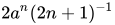

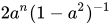

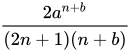
![{\displaystyle {\frac {d}{dx}}\left[(1-x^{2}){\frac {d}{dx}}\right]f(x)\,}](https://wikimedia.org/api/rest_v1/media/math/render/svg/48de115672b821258f92fe1b6f252b77526325a0)
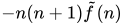
![{\displaystyle \left\{{\frac {d}{dx}}\left[(1-x^{2}){\frac {d}{dx}}\right]\right\}^{k}f(x)\,}](https://wikimedia.org/api/rest_v1/media/math/render/svg/aa0c542720c2a0c210fbd39959aa4e6e9b75b86a)

![{\displaystyle {\frac {f(x)}{4}}-{\frac {d}{dx}}\left[(1-x^{2}){\frac {d}{dx}}\right]f(x)\,}](https://wikimedia.org/api/rest_v1/media/math/render/svg/284e0b487df466ca8050d215e4bfa19ac4e4c36b)