Lepelletier planetary gearset
World's first 7-speed epicyclic gearset from 1992
From Wikipedia, the free encyclopedia
In 1992, Pierre A. G. Lepelletier proposed three degrees of freedom epicyclic gearset.[1] These are now known as Lepelletier planetary gearset or Lepelletier gear mechanisms.[2] It is a combination of a planetary gearset and a compound Ravigneaux gearset.[3]
History
The transmission was the first of its kind to offer additional gear ratios by combining serial and parallel power flow without increasing the complexity of the design.
Due to these advantages, this gearset concept became widely used in automatic vehicle transmissions. ZF was the first to start series production in 2000. Aisin/Toyota, Ford, and GM followed in 2005. For the first time, the construction costs could be reduced compared to the respective predecessor models.
Planetary gearset concept
Improved fuel economy
The main objective in replacing the predecessor model was to improve vehicle fuel economy with extra speeds and a wider gear span to allow the engine speed level to be lowered (downspeeding), which is a decisive factor in improving energy efficiency and thus reducing fuel consumption. In addition, the lower engine speed level improves the noise-vibration-harshness comfort and the exterior noise is reduced.
It has a torque converter lock-up for all 6 forward gears, which can be fully disengage when stationary, largely closing the fuel efficiency gap between vehicles with automatic and manual transmissions.
Reduced manufacturing complexity
In order to avoid a further increase in manufacturing complexity while expanding the number of gear ratios, all major manufacturers switched from the conventional design method—in which the planetary gearset concept was limited to a purely serial or in-line power flow—to a more modern design method that utilizes a planetary gearset concept with combined parallel and serial power flow. This was only possible thanks to computer-aided design and has resulted in a globally patented gearset concept. The resulting progress is reflected in a better ratio of the number of gears to the number of components used compared to existing layouts.
 , ...
, ...| With Assessment |
Output: Gear Ratios |
Innovation Elasticity[b] Δ Output : Δ Input |
Input: Main Components | |||
|---|---|---|---|---|---|---|
| Total | Gearsets | Brakes | Clutches | |||
| 6HP Ref. Object |
Topic[b] | |||||
| Δ Number | ||||||
| Relative Δ | Δ Output |
· |
Δ Input |
|||
| 6HP 5HP 24/30[c] |
6[d] 5[d] |
Progress[b] | 8 9 |
3[e] 3 |
2 3 |
3 3 |
| Δ Number | 1 | -1 | 0 | -1 | 0 | |
| Relative Δ | 0.200 |
−1.800[b] · |
−0.111 |
0.000 |
−0.333 |
0.000 |
| 6HP 5HP 18/19[c] |
6[d] 5[d] |
Progress[b] | 8 10 |
3[e] 3[e] |
2 3 |
3 4 |
| Δ Number | 1 | -2 | 0 | -1 | -1 | |
| Relative Δ | 0.200 |
−1.000[b] · |
−0.200 |
0.000 |
−0.333 |
−0.250 |
| 6HP 3-Speed[f] |
6[d] 3[d] |
Market Position[b] | 8 7 |
3[e] 2 |
2 3 |
3 2 |
| Δ Number | 3 | 1 | 1 | -1 | 1 | |
| Relative Δ | 1.000 |
7.000[b] · |
0.143 |
0.500 |
−0.333 |
0.500 |
| ||||||


No use of 5th (direct) gear from the original concept
The Lepelletier gearset concept actually provides 7 forward gears. However, the 5th gear, which is configured as a direct gear (ratio 1.00) in this configuration, requires a releaseable brake for S1 (sun gear of the first gearset, which is the simple one) and thus a 6th shifting element without any corresponding benefit: with ratios of approximately 1.15 and 0.85, the 4th and 6th gears are so close together that the 5th gear can easily be dispensed with. This means that all manufacturers can manage with 5 shifting elements and all transmissions built have 6 gear ratios instead of the possible 7.
Quality
The ratios of the 6 gears are nicely evenly distributed in all versions. Exceptions are the large step from 1st to 2nd gear and the almost geometric steps from 3rd to 4th to 5th gear. They cannot be eliminated without affecting all other gears. As the large step is shifted due to the large span to a lower speed range than with conventional gearboxes, it is less significant. As the gear steps are smaller overall due to the additional gear(s), the geometric gear steps are still smaller than the corresponding gear steps of conventional gearboxes. Overall, therefore, the weaknesses are not overly significant. As the selected gearset concept saves up to 2 components compared to 5-speed transmissions, the advantages clearly outweigh the disadvantages.
The layout brings the ability to shift in a non-sequential manner – going from gear 6 to gear 2 in extreme situations simply by changing one shift element (actuating clutch E and releasing brake A).
 ,
,  ...
...| In-Depth Analysis[c] With Assessment And Torque Ratio[d] And Efficiency Calculation[e] |
Planetary Gearset: Teeth[f] Lepelletier Gear Mechanism |
Count | Nomi- nal[g] Effec- tive[h] |
Cen- ter[i] | |||
|---|---|---|---|---|---|---|---|
| Simple | Ravigneaux | Avg.[j] | |||||
| Make[k] Model |
Version First Delivery |
S1[l] R1[m] |
S2[n] R2[o] |
S3[p] R3[q] |
Brakes Clutches |
Ratio Span |
Gear Step[r] |
| Gear | R | 1 | 2 | 3 | 4 | 5 | 6 |
| Gear Ratio[c] |
[c] | [c] | [c] | [c] | [c] | [c] | [c] |
| Step[r] | [s] | [t] | |||||
| Δ Step[u][v] | |||||||
| Shaft Speed |
|||||||
| Δ Shaft Speed[w] |
|||||||
| Torque Ratio[d] |
[d] | [d] | [d] | [d] | [d] | [d] | [d] |
| Efficiency [e] |
[e] | [e] | [e] | [e] | [e] | [e] | [e] |
| 2000: first manufacturer to use the Lepelletier gearset mechanism: ZF 6HP 1st generation | |||||||
| ZF 6HP 26[x] ZF 6HP 19[x] ZF 6HP 32[x] |
600 N⋅m (443 lb⋅ft) 400 N⋅m (295 lb⋅ft)[y] 750 N⋅m (553 lb⋅ft)[4] 2000 (all) |
37 71 |
31 38 |
38 85 |
2 3 |
6.0354 4.9236 [h][s] |
1.6977 |
| 1.4327[r] | |||||||
| Gear | R | 1 | 2 | 3 | 4 | 5 | 6 |
| Gear Ratio[c] |
−3.4025 [s][h] |
4.1708 |
2.3397 [t] |
1.5211 |
1.1428 [v][w] |
0.8672 |
0.6911 |
| Step | 0.8158[s] | 1.0000 | 1.7826[t] | 1.5382 | 1.3311 | 1.3178 | 1.2549 |
| Δ Step[u] | 1.1589 | 1.1559 | 1.0101[v] | 1.0502 | |||
| Speed | -1.2258 | 1.0000 | 1.7826 | 2.7419 | 3.6497 | 4.8096 | 6.0354 |
| Δ Speed | 1.2258 | 1.0000 | 0.7826 | 0.9593 | 0.9078[w] | 1.1599 | 1.2258 |
| Torque Ratio[d] |
–3.3116 –3.2665 |
4.0186 3.9436 |
2.2837 2.2559 |
1.5107 1.5055 |
1.1359 1.1325 |
0.8633 0.8613 |
0.6867 0.6845 |
| Efficiency [e] |
0.9733 0.9600 |
0.9635 0.9455 |
0.9761 0.9642 |
0.9931 0.9897 |
0.9939 0.9910 |
0.9955 0.9932 |
0.9937 0.9905 |
| 2007: ZF 6HP 2nd generation | |||||||
| ZF 6HP 28[x] ZF 6HP 21[x] ZF 6HP 34[x] |
600 N⋅m (443 lb⋅ft) 450 N⋅m (332 lb⋅ft)[z] 750 N⋅m (553 lb⋅ft)[aa] 2007 (all) |
37 71 |
31 38 |
38 85 |
2 3 |
6.0354 4.9236 [h][s] |
1.6977 |
| 1.4327[r] | |||||||
| Gear | R | 1 | 2 | 3 | 4 | 5 | 6 |
| Gear Ratio[c] |
−3.4025 [s][h] |
4.1708 | 2.3397 [t] |
1.5211 | 1.1428 [v][w] |
0.8672 | 0.6911 |
| Other manufacturer using the Lepelletier gear mechanism | |||||||
| Aisin AWTF-80 SC |
450 N⋅m (332 lb⋅ft)[7] 2005 |
50 90 |
36 44 |
44 96 |
2 3 |
6.0494 4.9495 [h][s] |
1.6865 |
| 1.4333[r] | |||||||
| Gear | R | 1 | 2 | 3 | 4 | 5 | 6 |
| Gear Ratio[c] |
−3.3939[s][h] |
4.1481 |
2.3704[t] |
1.5556 |
1.1546[v] |
0.8593 |
0.6857[w] |
| Step | 0.8182[s] | 1.0000 | 1.7500[t] | 1.5238 | 1.3472 | 1.3436 | 1.2532 |
| Δ Step[u] | 1.1484 | 1.1311 | 1.0027[v] | 1.0722 | |||
| Speed | -1.2222 | 1.0000 | 1.7500 | 2.6667 | 3.5926 | 4.8272 | 6.0494 |
| Δ Speed | 1.2222 | 1.0000 | 0.7500 | 0.9167 | 0.9259 | 1.2346 | 1.2222[w] |
| Torque Ratio[d] |
–3.3023 –3.2568 |
3.9956 3.9204 |
2.3127 2.2841 |
1.5444 1.5389 |
1.1471 1.1434 |
0.8553 0.8532 |
0.6813 0.6791 |
| Efficiency [e] |
0.9730 0.9596 |
0.9632 0.9451 |
0.9757 0.9636 |
0.9929 0.9893 |
0.9935 0.9903 |
0.9953 0.9928 |
0.9936 0.9904 |
| Ford 6R 60 6R 80 |
600 N⋅m (443 lb⋅ft) 800 N⋅m (590 lb⋅ft) 2005 (all) |
37 71 |
31 38 |
38 85 |
2 3 |
6.0354 4.9236 [h][s] |
1.6977 |
| 1.4327[r] | |||||||
| Gear | R | 1 | 2 | 3 | 4 | 5 | 6 |
| Gear Ratio[c] |
−3.4025 [s][h] |
4.1708 | 2.3397 [t] |
1.5211 | 1.1428 [v][w] |
0.8672 | 0.6911 |
| Ford 6R 140 |
1,400 N⋅m (1,033 lb⋅ft) 2005 |
49 95 |
37 47 |
47 97 |
2 3 |
5.8993 4.6441 [h][s] |
1.6361 |
| 1.4261[r] | |||||||
| Gear | R | 1 | 2 | 3 | 4 | 5 | 6 |
| Gear Ratio[c] |
−3.1283 [s][h] |
3.9738 |
2.3181 [t][v] |
1.5158 |
1.1492 [v][w] |
0.8585 |
0.6736 |
| Step | 0.7872[s] | 1.0000 | 1.7143[t] | 1.5293 | 1.3190 | 1.3389 | 1.2744 |
| Δ Step[u] | 1.1210[v] | 1.1594 | 0.9854[v] | 1.0504 | |||
| Speed | -1.2703 | 1.0000 | 1.7143 | 2.6216 | 3.4580 | 4.6290 | 5.8993 |
| Δ Speed | 1.2703 | 1.0000 | 0.7143 | 0.9073 | 0.8364[w] | 1.1710 | 1.2703 |
| Torque Ratio[d] |
–3.0449 –3.0035 |
3.8290 3.7576 |
2.2615 2.2333 |
1.5055 1.5003 |
1.1419 1.1383 |
0.8543 0.8522 |
0.6692 0.6669 |
| Efficiency [e] |
0.9733 0.9601 |
0.9635 0.9456 |
0.9756 0.9635 |
0.9932 0.9898 |
0.9937 0.9906 |
0.9952 0.9927 |
0.9934 0.9900 |
| GM 6L 45 6L 50 |
500 N⋅m (369 lb⋅ft) 2006 |
49 89 |
37 47 |
47 97 |
2 3 |
6.0346 4.7507 [h][s] |
1.6548 |
| 1.4326[r] | |||||||
| Gear | R | 1 | 2 | 3 | 4 | 5 | 6 |
| Gear Ratio[c] |
−3.2001 [s][h] |
4.0650 |
2.3712 [t][v] |
1.5506 |
1.1567 [v][w] |
0.8532 |
0.6736 |
| Step | 0.7872[s] | 1.0000 | 1.7143[t] | 1.5293 | 1.3406 | 1.3557 | 1.2662 |
| Δ Step[u] | 1.1210[v] | 1.1408 | 0.9889[v] | 1.0703 | |||
| Speed | -1.2703 | 1.0000 | 1.7143 | 2.6216 | 3.5144 | 4.7643 | 6.0346 |
| Δ Speed | 1.2703 | 1.0000 | 0.7143 | 0.9073 | 0.8928[w] | 1.2499 | 1.2703 |
| Torque Ratio[d] |
–3.1138 –3.0710 |
3.9156 3.8421 |
2.3127 2.2826 |
1.5396 1.5340 |
1.1490 1.1453 |
0.8490 0.8468 |
0.6692 0.6692 |
| Efficiency [e] |
0.9730 0.9597 |
0.9633 0.9452 |
0.9753 0.9630 |
0.9929 0.9893 |
0.9934 0.9902 |
0.9951 0.9925 |
0.9934 0.9900 |
| GM 6L 80 6L 90 |
800 N⋅m (590 lb⋅ft) 2005 |
50 94 |
35 46 |
46 92 |
2 3 |
6.0401 4.5957 [h][s] |
1.6384 |
| 1.4329[r] | |||||||
| Gear | R | 1 | 2 | 3 | 4 | 5 | 6 |
| Gear Ratio[c] |
−3.0638 [s][h] |
4.0267 |
2.3635 [t][v] |
1.5319 |
1.1522 [v][w] |
0.8521 |
0.6667 |
| Step | 0.7609[s] | 1.0000 | 1.7037[t] | 1.5429 | 1.3296 | 1.3522 | 1.2781 |
| Δ Step[u] | 1.1043[v] | 1.1604 | 0.9832[v] | 1.0580 | |||
| Speed | -1.3143 | 1.0000 | 1.7037 | 2.6286 | 3.4948 | 4.7258 | 6.0401 |
| Δ Speed | 1.3143 | 1.0000 | 0.7037 | 0.9249 | 0.8662[w] | 1.2310 | 1.3143 |
| Torque Ratio[d] |
–2.9817 –2.9410 |
3.8794 3.8068 |
2.3048 2.2756 |
1.5213 1.5160 |
1.1448 1.1412 |
0.8478 0.8456 |
0.6622 0.6599 |
| Efficiency [e] |
0.9732 0.9599 |
0.9634 0.9454 |
0.9751 0.9628 |
0.9931 0.9896 |
0.9936 0.9904 |
0.9950 0.9924 |
0.9932 0.9898 |
| Actuated Shift Elements[ab] | |||||||
| Brake A[ac] | ❶ | ❶ | ❶ | ❶ | |||
| Brake B[ad] | ❶ | ❶ | ❶ | ||||
| Clutch C[ae] | ❶ | ❶ | |||||
| Clutch D[af] | ❶ | ❶ | |||||
| Clutch E[ag] | ❶ | ❶ | ❶ | ||||
| Geometric Ratios: Speed Conversion | |||||||
| Gear Ratio[c] R & 3 & 6 Ordinary[ah] Elementary Noted[ai] |
|||||||
| Gear Ratio[c] 1 & 2 Ordinary[ah] Elementary Noted[ai] |
|||||||
| Gear Ratio[c] 4 & 5 Ordinary[ah] Elementary Noted[ai] |
|||||||
| Kinetic Ratios: Torque Conversion | |||||||
| Torque Ratio[d] R & 3 & 6 |
|||||||
| Torque Ratio[d] 1 & 2 |
|||||||
| Torque Ratio[d] 4 & 5 |
|||||||
| |||||||


Illustration
In the illustrations, the Ravigneaux gearset is shown vertically mirrored, contrary to actual practice, for the sake of clarity.
 Reverse gear
 Neutral
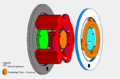 1st gear
 2nd gear
 3rd gear
 4th gear
 5th gear: not used in actual existing gearboxes
 6th gear: 5th gear in actual existing gearboxes
 7th gear: 6th gear in actual existing gearboxes


Limitations
The limitations of the Lepelletier gearset mechanism lie in the number of gear ratios provided and in the efficiency issues that Ravigneaux gearsets always contend with. Therefore, starting in 2008 with the ZF 8HP, the Lepelletier gearset mechanism was replaced by gearset concepts with even more gears and largely dispensing with the use of Ravigneaux gearsets. This was followed later by the GM 8L, Aisin-Toyota 8-speed transmission, and the Ford-GM 10-speed transmission, for example.
Applications
The gearset was used in a wide range of automatic vehicle transmissions.