Leptospermum thompsonii
From Wikipedia, the free encyclopedia
| Monga tea-tree | |
|---|---|
 | |
| Near Clyde Mountain | |
Scientific classification  | |
| Kingdom: | Plantae |
| Clade: | Tracheophytes |
| Clade: | Angiosperms |
| Clade: | Eudicots |
| Clade: | Rosids |
| Order: | Myrtales |
| Family: | Myrtaceae |
| Genus: | Leptospermum |
| Species: | L. thompsonii |
| Binomial name | |
| Leptospermum thompsonii | |
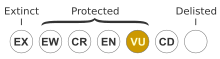
Leptospermum thompsonii, commonly known as the monga tea-tree,[2] is a species of tall shrub that is endemic to south eastern New South Wales. It has rough, flaky bark, broadly elliptical to egg-shaped leaves with the narrower end towards the base, and a sharply-pointed tip, white flowers and fruit that remains on the plant at maturity.
Leptospermum thompsonii is an erect shrub of that grows to a height of 1–6 m (3 ft 3 in – 19 ft 8 in) and rough, fibrous or flaky bark and young stems that are covered with soft hairs. The leaves are elliptical to egg-shaped with the narrower end towards the base, mostly 10–15 mm (0.39–0.59 in) long and 4–6 mm (0.16–0.24 in) wide with a sharply-pointed tip and tapering to a short petiole. The flowers are white, about 15 mm (0.59 in) wide and arranged singly on short side shoots. The floral cup is covered with soft hairs, about 4 mm (0.16 in) long tapering to a very short pedicel. The sepals are also hairy, broadly egg-shaped, about 3 mm (0.12 in) long, the five petals 4–6 mm (0.16–0.24 in) long and the stamens 2–3 mm (0.079–0.118 in) long. Flowering mostly occurs from December to March and the fruit is a capsule about 10 mm (0.39 in) wide that remains on the plant at maturity.[2][3][4]
Taxonomy and naming
Leptospermum thompsonii was first formally described in 1989 by Joy Thompson in the journal Telopea from specimens collected by John Boorman in 1915.[3][5][6] The specific epithet (thompsonii) honours M.M.H. Thompson, the husband of the describing botanist, for his "assistance in the collection and field study of this and many other species".[3]