Lilium philadelphicum
Species of lily
From Wikipedia, the free encyclopedia
Lilium philadelphicum, also known as the wood lily,[3] flame lily,[4] Philadelphia lily, (wild) tiger lily, prairie lily, or western red lily, is a perennial species of lily native to North America.

| Lilium philadelphicum | |
|---|---|
| |
Scientific classification  | |
| Kingdom: | Plantae |
| Clade: | Embryophytes |
| Clade: | Tracheophytes |
| Clade: | Spermatophytes |
| Clade: | Angiosperms |
| Clade: | Monocots |
| Order: | Liliales |
| Family: | Liliaceae |
| Subfamily: | Lilioideae |
| Genus: | Lilium |
| Species: | L. philadelphicum |
| Binomial name | |
| Lilium philadelphicum | |
| Synonyms[2] | |
| |

Distribution
The plant is widely distributed in much of Canada from British Columbia to Quebec, and parts of the United States (Northeast and Great Lakes regions plus the Rocky and Appalachian Mountains).[5][6]
Description
Lilium philadelphicum grows to a height of approximately 30 to 90 centimeters. It produces red or orange blooms between June and August.[7]
Varieties
- Lilium philadelphicum var. andinum—western wood lily, native to Midwestern U.S., Great Plains, and Western U.S. regions.[8] It is the floral emblem of the province of Saskatchewan in Canada, and is on the flag of Saskatchewan.[9][10][11]
Conservation
Lilium philadelphicum is listed as an endangered species in Maryland, New Mexico, Tennessee, North Carolina[5][12] and Ohio.[13] Its status is a threatened species in Kentucky.[5]
As the Saskatchewan provincial floral emblem, it is protected under the Provincial Emblems and Honours Act, and cannot be picked, uprooted or destroyed in any manner.[10][9]
Toxicity
Cats are extremely sensitive to lily toxicity and ingestion is often fatal.[14][15][16] Households and gardens that are visited by cats are strongly advised against keeping this plant or placing dried flowers where a cat may brush against them and become dusted with pollen that they then consume while cleaning. Suspected cases require urgent veterinary attention.[17]
Rapid treatment with activated charcoal and/or induced vomiting can reduce the amount of toxin absorbed (this is time-sensitive so in some cases, vets may advise doing it at home), and large amounts of fluid by intravenous injection can reduce damage to kidneys to increase the chances of survival.[17]
Traditional uses
The bulbs were eaten by some Native Americans.[18]
Gallery
 Flower with foliage
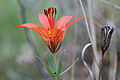 Side view of flower
 Immature flower
 Rare yellow form in Logan County, North Dakota, USA
 Exhibit at Callaway Gardens


.jpg)


.JPG)