Linear biochemical pathway
From Wikipedia, the free encyclopedia
A linear biochemical pathway is a chain of enzyme-catalyzed reaction steps where the product of one reaction becomes the substrate for the next reaction. The molecules progress through the pathway sequentially from the starting substrate to the final product. Each step in the pathway is usually facilitated by a different specific enzyme that catalyzes the chemical transformation. An example includes DNA replication, which connects the starting substrate and the end product in a straightforward sequence.
Biological cells consume nutrients to sustain life. These nutrients are broken down to smaller molecules. Some of the molecules are used in the cells for various biological functions, and others are reassembled into more complex structures required for life. The breakdown and reassembly of nutrients is called metabolism. An individual cell contains thousands of different kinds of small molecules, such as sugars, lipids, and amino acids. The interconversion of these molecules is carried out by catalysts called enzymes. For example, the most widely studied bacterium, E. coli strain K-12, is able to produce about 2,338 metabolic enzymes.[1] These enzymes collectively form a complex web of reactions comprising pathways by which substrates (including nutrients and intermediates) are converted to products (other intermediates and end-products).
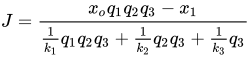
The figure below shows a four step pathway, with intermediates, and . To sustain a steady-state, the boundary species and are fixed. Each step is catalyzed by an enzyme, .


Linear pathways follow a step-by-step sequence, where each enzymatic reaction results in the transformation of a substrate into an intermediate product. This intermediate is processed by subsequent enzymes until the final product is synthesized.

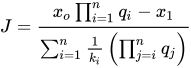
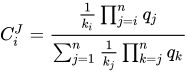
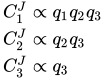
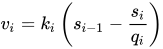
A linear pathway can be studied in various ways. Multiple computer simulations can be run to try to understand the pathway's behavior. Another way to understand the properties of a linear pathway is to take a more analytical approach. Analytical solutions can be derived for the steady-state if simple mass-action kinetics are assumed.[2][3][4] Analytical solutions for the steady-state when assuming Michaelis-Menten kinetics can be obtained[5][6] but are quite often avoided. Instead, such models are linearized. The three approaches that are usually used are therefore:
- Computer simulation
- Analytical solutions using a linear mathematical model
- Linearization of a non-linear model
It is possible to build a computer simulation of a linear biochemical pathway. This can be done by building a simple model that describes each intermediate through a differential equation. The differential equations can be written by invoking mass conservation. For example, for the linear pathway:

where and are fixed boundary species, the non-fixed intermediate can be described using the differential equation:

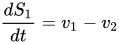
The rate of change of the non-fixed intermediates and can be written in the same way:

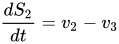
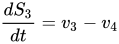
To run a simulation the rates, need to be defined. If mass-action kinetics are assumed for the reaction rates, then the differential equation can be written as:

![{\displaystyle {\begin{array}{lcl}{\dfrac {dS_{1}}{dt}}&=&k_{1}X_{o}-k_{2}S_{1}\\[4pt]{\dfrac {dS_{2}}{dt}}&=&k_{2}S_{1}-k_{3}S_{2}\\[4pt]{\dfrac {dS_{3}}{dt}}&=&k_{3}S_{2}-k_{4}S_{3}\end{array}}}](https://wikimedia.org/api/rest_v1/media/math/render/svg/9b7fb937064f4d4ac690003242fa31575b2fdf4f)
If values are assigned to the rate constants, , and the fixed species and the differential equations can be solved.





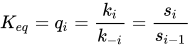



![{\displaystyle {\begin{aligned}&s_{1}={\frac {q_{1}}{q_{3}}}{\frac {k_{2}k_{3}x_{1}+k_{1}k_{2}q_{3}x_{o}+k_{1}k_{3}q_{2}q_{3}x_{o}}{k_{1}k_{2}+k_{1}k_{3}q_{2}+k_{2}k_{3}q_{1}q_{2}}}\\[6pt]&s_{2}={\frac {q_{2}}{q_{3}}}{\frac {k_{1}k_{3}x_{1}+k_{2}k_{3}q_{1}x_{1}+k_{1}k_{2}q_{1}q_{3}x_{o}}{k_{1}k_{2}+k_{1}k_{3}q_{2}+k_{2}k_{3}q_{1}q_{2}}}\end{aligned}}}](https://wikimedia.org/api/rest_v1/media/math/render/svg/ef013df5d93d10469c218af9ca495fad063c312b)