List of indefinite sums
From Wikipedia, the free encyclopedia
This is a list of indefinite sums (also known as antidifferences) of various functions. An indefinite sum is the inverse of the forward difference operator , defined as . It satisfies the relation




The operator is defined only up to an additive periodic function with period 1.
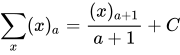
For positive integer exponents, Faulhaber's formula can be used. Note that in the result of Faulhaber's formula must be replaced with due to the offset, as Faulhaber's formula finds rather than .


For negative integer exponents, the indefinite sum is closely related to the polygamma function:[1]

For fractions not listed in this section, one may use the polygamma function with partial fraction decomposition. More generally,[1]

where are the Bernoulli polynomials, is the Hurwitz zeta function, and is the digamma function. This is related to the generalized harmonic numbers.


As the generalized harmonic numbers use reciprocal powers, must be substituted for , and the most common form uses the inverse of the backward difference offset:[1]


Here, is the constant .


The Bernoulli polynomials are also related via a partial derivative with respect to :[citation needed]

This relationship can be expressed via the inverse backward difference operator as:

Further generalization comes from use of the Lerch transcendent:[citation needed]

which generalizes the generalized harmonic numbers as when taking .


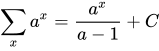
Antidifferences of exponential functions
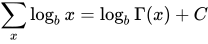
Antidifferences of logarithmic functions

Antidifferences of hyperbolic functions




Antidifferences of trigonometric functions





where is the q-digamma function.


The antidifference of the normalized sinc function can be obtained by applying the Abel–Plana formula presented in Candelpergher[1] with the shift , the condition , and recurrence of . Using the reflection formula for the digamma function, this simplifies to: