List of mathematical series
From Wikipedia, the free encyclopedia
This list of mathematical series contains formulae for finite and infinite sums. It can be used in conjunction with other tools for evaluating sums.
- Here, is taken to have the value
- denotes the fractional part of
- is a Bernoulli polynomial.
- is a Bernoulli number, and here,
- is an Euler number.
- is the Riemann zeta function.
- is the gamma function.
- is a polygamma function.
- is a polylogarithm.
- is binomial coefficient
- denotes exponential of


Sums of powers
See Faulhaber's formula.
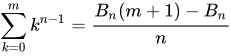
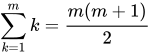
The first few values are:

![{\displaystyle \sum _{k=1}^{m}k^{3}=\left[{\frac {m(m+1)}{2}}\right]^{2}={\frac {m^{4}}{4}}+{\frac {m^{3}}{2}}+{\frac {m^{2}}{4}}}](http://wikimedia.org/api/rest_v1/media/math/render/svg/83655857c974dd27c9b29de8cda04d7c65d334e3)
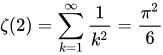
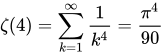
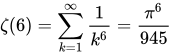
See zeta constants.

The first few values are:
- (the Basel problem)
Power series
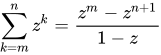
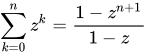
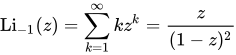
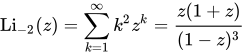
Low-order polylogarithms
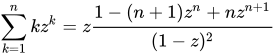
Finite sums:



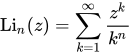
Infinite sums, valid for (see polylogarithm):

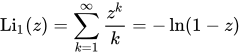
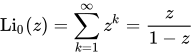
The following is a useful property to calculate low-integer-order polylogarithms recursively in closed form:



Exponential function
- (cf. mean of Poisson distribution)
- (cf. second moment of Poisson distribution)

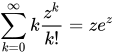
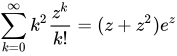
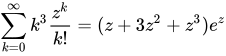
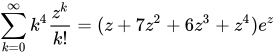

where is the Touchard polynomials.

Trigonometric, inverse trigonometric, hyperbolic, and inverse hyperbolic functions relationship
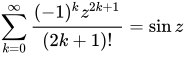
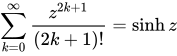
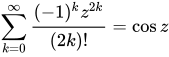
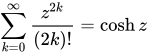



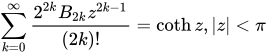



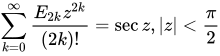
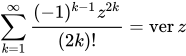




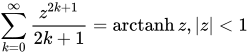


Modified-factorial denominators


![{\displaystyle \sum _{n=0}^{\infty }{\frac {\prod _{k=0}^{n-1}(4k^{2}+\alpha ^{2})}{(2n)!}}z^{2n}+\sum _{n=0}^{\infty }{\frac {\alpha \prod _{k=0}^{n-1}[(2k+1)^{2}+\alpha ^{2}]}{(2n+1)!}}z^{2n+1}=e^{\alpha \arcsin {z}},|z|\leq 1}](http://wikimedia.org/api/rest_v1/media/math/render/svg/7690094e2c29c30c517059014511d42f93f0912a)
Binomial coefficients
- (see Binomial theorem § Newton's generalized binomial theorem)
- [3]
- [3] , generating function of the Catalan numbers
- [3] , generating function of the Central binomial coefficients
- [3]
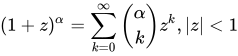


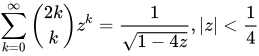


Harmonic numbers
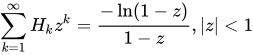
(See harmonic numbers, themselves defined , and generalized to the real numbers)


![{\displaystyle \sum _{k=1}^{\infty }{\frac {H_{k}}{k+1}}z^{k+1}={\frac {1}{2}}\left[\ln(1-z)\right]^{2},\qquad |z|<1}](http://wikimedia.org/api/rest_v1/media/math/render/svg/a1c2c3f140738f0c5c61f88f041f311fbda3a340)



Binomial coefficients
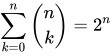
- (see Multiset)
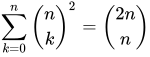
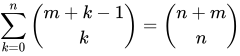
- (see Vandermonde identity)





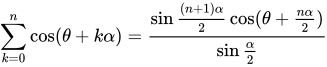
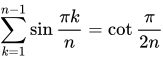
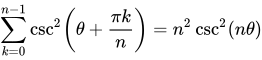
Trigonometric functions

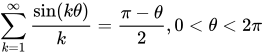



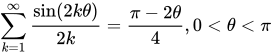
![{\displaystyle \sum _{k=0}^{\infty }{\frac {\cos[(2k+1)\theta ]}{2k+1}}={\frac {1}{2}}\ln \left(\cot {\frac {\theta }{2}}\right),0<\theta <\pi }](http://wikimedia.org/api/rest_v1/media/math/render/svg/d1991f46f491715b581a7037b4125c14fe65025c)
![{\displaystyle \sum _{k=0}^{\infty }{\frac {\sin[(2k+1)\theta ]}{2k+1}}={\frac {\pi }{4}},0<\theta <\pi }](http://wikimedia.org/api/rest_v1/media/math/render/svg/faf41e942b227c04e70af874e45bddb621602e58)




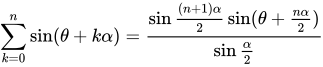
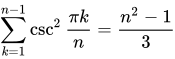
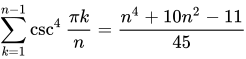
Roots of unity
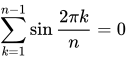
A 'th root of unity is a solution to the equation and they can be written like:


The following summation identities hold:


Let be an integer then we also got:


Rational functions
- [7]
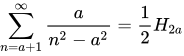
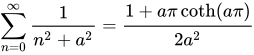
- An infinite series of any rational function of can be reduced to a finite series of polygamma functions, by use of partial fraction decomposition,[8] as explained here. This fact can also be applied to finite series of rational functions, allowing the result to be computed in constant time even when the series contains a large number of terms.
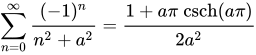


Exponential function
- (see the Landsberg–Schaar relation)

![{\displaystyle \displaystyle \sum _{n=-\infty }^{\infty }e^{-\pi n^{2}}={\frac {\sqrt[{4}]{\pi }}{\Gamma \left({\frac {3}{4}}\right)}}}](http://wikimedia.org/api/rest_v1/media/math/render/svg/4aee717a740629f569ad7c408608acb53f1ec4bd)
Numeric series
These numeric series can be found by plugging in numbers from the series listed above.
Alternating harmonic series


Alternating arithmetic series
Let be defined as:


where are positive whole numbers. Then if we can write and , where , and get:


Now if we can, per Euclid's division lemma, write where and then


where we now can add the remaining rows back and subtract them to give us:

what that means is that all the infinite choices of and can essentially be boiled down to the cases where and . If we assume those two things we can then write:


and in the case of using a negative sign instead:

the same two rules apply from above apply and then we can do the following for the case with (since ):


Let us test out the formula:

Sum of reciprocal of factorials




Trigonometry and π





Reciprocal of tetrahedral numbers

Where
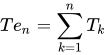
Exponential and logarithms
- , that is




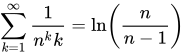


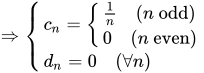
![{\displaystyle {\frac {\pi }{4}}=\sum _{n=0}^{\infty }c_{n}\sin[nx]+d_{n}\cos[nx]}](http://wikimedia.org/api/rest_v1/media/math/render/svg/3a5b6fd91cf5e77255955c2b09cdc203bcb5bf73)