| Building |
|
Location |
First Built |
Inscription |
| Las Piñas Church |
 |
Las Piñas |
1819[14] |
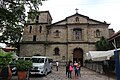
Established as a pueblo, 1762. Separated from the parish of Parañaque, 1775. P. Diego Cera de la Virgen del Carmen appointed first resident parish priest, December 26, 1795. The stone church was erected, 1797–1819. He created the bamboo organ from 902 bamboo tubes and 129 tin cans, 1816–1824. Slightly damaged by the earthquakes of 1828 and 1863. After the 1880 earthquakes, the church was temporarily abandoned. It was renovated in 1883 but had not been fully repaired. It was used as a concentration camp during the Japanese occupation and as a hospital during the Liberation. Restored to its former use through a joint effort by the parish community and the Historical Conservation Society, 1962–1977. |
| Malate Church |
 |
Malate |
1864[15] |
This section of the city dates back to 1588. The titular patroness of this church is Nuestra Señora de los Remedios, whose statue was brought from Spain in 1624 by Rev. Juan Guevara, O.S.A. The British landed their troops near these shores in 1762 and used the church of Malate for protection for their rear-guard in the capture of Manila. This church was greatly damaged by the earthquake of June 3, 1863, and was rebuilt by Rev. Francisco Cuadrado, O.S.A. The parish has been under the successive administration of the Augustinians, the secular clergy, the Redemptorists, and the Columbans. |
| Tondo Church |
 |
Tondo |
1880[16] |
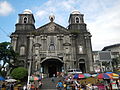
The first Catholic minister of Tondo was the Rev. Alonso de Alvarado, O.S.A. Tondo was the residence of Lakan-Dula who was baptized by the Rev. Martin de Rada, O.S.A. In the early days, its ecclesiastical jurisdiction extended up to Pasig, Cainta and Taytay. Tondo was an active center of Catholic activities among the Chinese. The former convent was demolished in 1662 by Governor Sabiniano Manrique de Lara as a military precaution against the expected attack on Manila by Kue-Sing. The present church was built by the Rev. Manuel Diez, O.S.A. and the Rev. Casimiro Herrero, O.S.A. in the second half of the 19th century. Since the early days, the traditional fluvial procession of Santo Niño has attracted thousands of visitors to Tondo. |
| San Sebastian Church |
 |
Quiapo |
1891[17] |
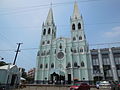
Designed by Genaro Palacios. The structural metal of which this church is uniquely built was manufactured in Belgium and erected here by Belgian engineers. The church was solemnly blessed August 16, 1891. Earlier churches built on this site by Recollect friars since 1611 were destroyed by earthquake in 1859, 1863 and 1880. |
| Tutuban station |
 |
Tondo |
1892[18] |
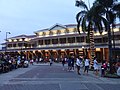
Preparation of general plan for railroad on Luzon authorized by royal decree, June 26, 1875. Royal approval of Don Eduardo López Navarro's plan, May 11, 1883. Concession for the Manila–Dagupan line awarded to Don Edmundo Sykes, January 21, 1887, and later transferred to the Manila Railroad Company Ltd. of London. Corner stone of the main station building at Tutuban laid July 31, 1887. Entire Manila–Dagupan line, 195 kilometers long, completed and service inaugurated November 24, 1892. |
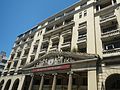
| Don Roman Santos Building |
 |
Santa Cruz |
1894[19] |
The building was occupied by Caja Ahorros y Monte de Piedad between 1894 and 1937. It was purchased and expanded by the Consolidated Investments Corporation and resold to the Magdalena Estate in 1944. Transformed into a hospital by American Red Cross, 1945–1947 . Roman R. Santos purchased it in 1955 and was occupied by the Prudential Bank and Trust Company and trading offices. Its renovation was completed in 1957. |
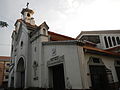
| Pinaglabanan Church |
 |
San Juan |
1896[20] |
Designed and built by architect Luis Arellano in 1896 with the help of Mariano Artiaga and Martín Ocampo. Destroyed during the revolution; Restored by Ramón J. Fernández after the Philippine-American war and became the parish of San Juan. The church was enlarged and renovated in 1951 under the leadership of parish priest, P. Hernando Antiporda. The improvement was made by architect Otilio A. Arellano who worked hard to maintain its original nave and façade. |
| Taguig Church |
 |
Taguig |
1896[21] |
Augustine priests established the parish under the patronage of the patron saint of Santa Ana. The first parish priest P. Diego Álvarez built and erected the first stone church in 1587. It was destroyed by the earthquake, 1645, and rebuilt by P. Andrés Díaz, 1848. It was damaged by another earthquake, 1882, and was rebuilt by P Guillermo Díaz, 1886–1896. The church was renovated by Rt. Rev. Msgr. Augurio I. Juta, 1980–1985, and by Msgr. Emmanuel V. Sunga, 1985–1987. Presented to the Lord by the Honorable Bishop Bruno Torpigliani, Apostolic Nuncio in the Philippines, in commemoration of the 400th anniversary of the parish, July 25, 1987. |

_(17106345010).jpg)


.jpg)


.jpg)


