Lituus (mathematics)
From Wikipedia, the free encyclopedia

The lituus spiral (/ˈlɪtju.əs/) is a spiral in which the angle θ is inversely proportional to the square of the radius r.
This spiral, which has two branches depending on the sign of r, is asymptotic to the x axis. Its points of inflexion are at

The curve was named for the ancient Roman lituus by Roger Cotes in a collection of papers entitled Harmonia Mensurarum (1722), which was published six years after his death.
Polar coordinates
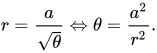
The representations of the lituus spiral in polar coordinates (r, θ) is given by the equation

where θ ≥ 0 and a ≠ 0.
Cartesian coordinates
The lituus spiral with the polar coordinates r = a/√θ can be converted to Cartesian coordinates like any other spiral with the relationships x = r cos θ and y = r sin θ. With this conversion we get the parametric representations of the curve:
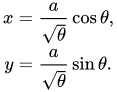
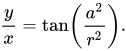
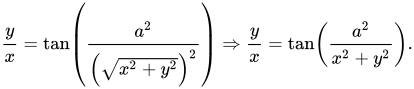
These equations can in turn be rearranged to an equation in x and y:
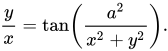
- Divide by :
- Solve the equation of the lituus spiral in polar coordinates:
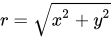
- Substitute :
- Substitute :