Local World Evolving Network Models
From Wikipedia, the free encyclopedia
An evolving network is a network that changes over time. In this type of network, components (called nodes) and the connections between them (called edges) can be added or removed. This dynamic behavior is a key feature of many real-world systems. For example:
- A social network evolves as people make new friends, join new communities, or lose touch with old acquaintances.
- The Internet evolves as new websites are created and linked to, while old ones are taken down.
- Transportation networks evolve as new roads or airline routes are added.
Studying how networks evolve helps researchers understand the growth and structure of complex systems. Different mathematical models have been developed to describe these changes, each capturing different rules for how nodes and edges are added or removed.
The structure of a network is determined by the process of its evolution. The main models that describe these processes differ in how new nodes choose which existing nodes to connect with. All the following models assume that newly added points have global information about the whole network, except for the local-world model
- Random networks follow the Erdős–Rényi model, where new nodes and edges are added to the network in a completely random way. This was one of the earliest models for network evolution.[1]
- Scale-free networks evolve through a process called preferential attachment. In this model, new nodes are more likely to connect to existing nodes that already have many connections—a "rich-get-richer" effect. This creates highly connected "hubs" and is described by the Barabási–Albert model.[2]
- Small-world networks are characterized by nodes that are highly clustered into local groups, yet are connected by short paths to any other node in the network. The Watts–Strogatz model describes networks that are neither completely regular nor completely random, but have this "small-world" property.[3]
- Local-world networks account for the fact that in many large systems, a new node only has knowledge of a small, local portion of the entire network. Therefore, it makes connections based on this limited local information rather than global knowledge. This concept was first described by Li and Chen (2003). The local world model was extended inter alia by Gardeñes and Moreno (2004), Qin and Dai,[4] Wen et al.[5] or Xuan et al.[6]
World Evolving Network Model of Li and Chen (2003)
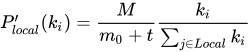
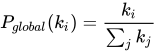
The model starts with the set of small number of nodes and the small number of edges . There are M nodes that were selected randomly from the whole global network, so that they constitute a so-called “local world” for new coming nodes. Thus, every new node with m edges connects only to m existing nodes from its local world and does not link with nodes which are in the global system (the main difference from the BA model). In such case, the probability of connection may be defined as:



Where and the term "Local-World" refers to all nodes, which are in interest of newly added node at time t. Thus, it may be rewritten:

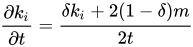
while the dynamics are:
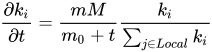
In every time t, it is true that , so that two corner solutions are possible: and .



Case A. Lower bounded limit M = m {\displaystyle M=m}
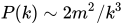
A new node connects only to nodes from the initially chosen local world M. This identifies that in network growing process, preferential attachment (PA) selection is not efficient. The case is identical with BA scale free model, in which network grows without PA. The rate of change of the i th node’s degree may be written in the following way:
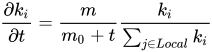
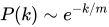
Thus, above proves that in the lower bound solution, network has an exponentially decayed degree distribution : (Fig.1)
Case B Lower bounded limit M = m 0 + t {\displaystyle M=m_{0}+t}
In this case local world behaves in the same way as the global network. It evolves in time. Therefore, LW model may be compared to Barabasi–Albert scale-free model, and the rate of change of the 'i th' node’s degree may be expressed as:

This equality indicates that in the upper bound solution, LW model follows the degree distribution of the power law: (Fig. 2)
Hence, from A and B, it may be found that among corner solutions, Li and Chen’s model represents a transition for the degree distribution between the exponential and the power-law (Fig.3).

![{\displaystyle \delta \in \left[0,1\right]}](https://wikimedia.org/api/rest_v1/media/math/render/svg/ac8f03370b357a40dd325517a2b9f15c80319045)









![{\displaystyle {\frac {\partial k_{i}}{\partial t}}=\left[{\frac {\delta }{2}}-{\frac {1+\delta }{1-\delta }}\right]{\frac {k_{i}}{t}}}](https://wikimedia.org/api/rest_v1/media/math/render/svg/a938c0dbfe9c9b1b27f8f391c0dfdb825bbf5d78)
![{\displaystyle \sum _{j\in local}k{j}=\sum _{j\in local}k_{j}=\left[\delta \left\langle k_{i}\right\rangle +(1-\delta )m\right]M}](https://wikimedia.org/api/rest_v1/media/math/render/svg/1c204ea2b6e3e75b2388c4760275d60b4ff4be3d)
