Log-polar coordinates
From Wikipedia, the free encyclopedia
In mathematics, log-polar coordinates (or logarithmic polar coordinates) is a coordinate system in two dimensions, where a point is identified by two numbers, one for the logarithm of the distance to a certain point, and one for an angle. Log-polar coordinates are closely connected to polar coordinates, which are usually used to describe domains in the plane with some sort of rotational symmetry. In areas like harmonic and complex analysis, the log-polar coordinates are more canonical than polar coordinates.
Log-polar coordinates in the plane consist of a pair of real numbers (ρ,θ), where ρ is the logarithm of the distance between a given point and the origin and θ is the angle between a line of reference (the x-axis) and the line through the origin and the point. The angular coordinate is the same as for polar coordinates, while the radial coordinate is transformed according to the rule
- .

Where is the distance to the origin. The formulas for transformation from Cartesian coordinates to log-polar coordinates are given by

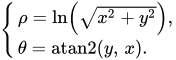
and the formulas for transformation from log-polar to Cartesian coordinates are
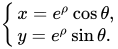
By using complex numbers (x, y) = x + iy, the latter transformation can be written as
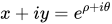
i.e. the complex exponential function. From this follows that basic equations in harmonic and complex analysis will have the same simple form as in Cartesian coordinates. This is not the case for polar coordinates.
Some important equations in log-polar coordinates
Laplace's equation
Laplace's equation in two dimensions is given by
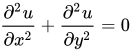
in Cartesian coordinates. Writing the same equation in polar coordinates gives the more complicated equation
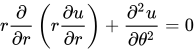
or equivalently

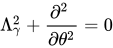
However, from the relation it follows that so Laplace's equation in log-polar coordinates,

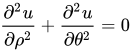
has the same simple expression as in Cartesian coordinates. This is true for all coordinate systems where the transformation to Cartesian coordinates is given by a conformal mapping. Thus, when considering Laplace's equation for a part of the plane with rotational symmetry, e.g. a circular disk, log-polar coordinates is the natural choice.
Cauchy–Riemann equations
A similar situation arises when considering analytical functions. An analytical function written in Cartesian coordinates satisfies the Cauchy–Riemann equations:

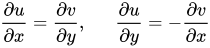
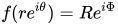
If the function instead is expressed in polar form , the Cauchy–Riemann equations take the more complicated form

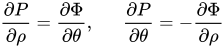
Just as in the case with Laplace's equation, the simple form of Cartesian coordinates is recovered by changing polar into log-polar coordinates (let ):

The Cauchy–Riemann equations can also be written in one single equation as
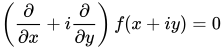
By expressing and in terms of and this equation can be written in the equivalent form


Euler's equation
When one wants to solve the Dirichlet problem in a domain with rotational symmetry, the usual thing to do is to use the method of separation of variables for partial differential equations for Laplace's equation in polar form. This means that you write . Laplace's equation is then separated into two ordinary differential equations


where is a constant. The first of these has constant coefficients and is easily solved. The second is a special case of Euler's equation


where are constants. This equation is usually solved by the ansatz , but through use of log-polar radius, it can be changed into an equation with constant coefficients:



When considering Laplace's equation, and so the equation for takes the simple form



When solving the Dirichlet problem in Cartesian coordinates, these are exactly the equations for and . Thus, once again the natural choice for a domain with rotational symmetry is not polar, but rather log-polar, coordinates.