The kinetics of radiolabeled compounds in a compartmental system can be described in terms of a set of first-order, constant-coefficient, ordinary differential equations.[4][5] The time course of the activity in the multicompartmental system driven by a metabolite-corrected plasma input function  can be described by:
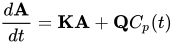
where  is a column vector of activity concentration for each compartment at time
  ,
,  is the matrix of the transfer constants between compartments, and
  is the vector of plasma-to-tissue transfer constants. Patlak and Blasberg[3] showed that the above equation can be written as:

where  represents a row vector of 1s and
 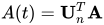 . The total activity in the region of interest,
  , is a combination of radioactivities from all compartments plus a plasma volume fraction (
 )[2] and thus:

By dividing both sides by , one obtains the following linear equation:

For  , Patlak and his colleagues[2] showed that
  , i.e., the steady-state condition. When this condition is satisfied, the intercept has reached its constant value so that after some time a plot of
  versus
 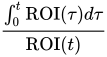 becomes a straight line with slope
  and intercept
 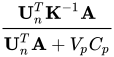 .[1]
.[1]
For a catenary two-tissue compartment model with transfer constants  (forward transport from plasma to tissue),
  (reverse transport from tissue to plasma),
  (binding parameter proportional to
  ), and
  (dissociation constant) to analyze enzyme or receptor system, the slope represents the total distribution volume (
 ) and is given by
 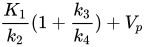 ,[1] where
  ,
,  ,
,  , and
, and 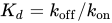 , in which
  is the concentration of ligand binding sites,
  is the equilibrium dissociation constant for the ligand-binding site complex,
  is the ligand-binding association constant,
  is the ligand-binding dissociation constant. For a one-tissue compartment model with transfer constants and , the slope is
  , where
  is the partition coefficient (
 ) and the intercept is
 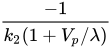 .[1]
.[1]