Logarithmic mean
Difference of two numbers divided by the logarithm of their quotient
From Wikipedia, the free encyclopedia
In mathematics, the logarithmic mean is a function of two non-negative numbers which is equal to their difference divided by the logarithm of their quotient. This calculation is applicable in engineering problems involving heat and mass transfer.
Definition
The logarithmic mean is defined by

for , such that .


Inequalities
The logarithmic mean of two numbers is smaller than the arithmetic mean and the generalized mean with exponent greater than 1. However, it is larger than the geometric mean and the harmonic mean, respectively. The inequalities are strict unless both numbers are equal.[1][2][3][4] More precisely, for with and , we have where the expressions in the chain of inequalities are, in order: the harmonic mean, the geometric mean, the logarithmic mean, the arithmetic mean, and the generalized arithmetic mean with exponent .


Derivation
Mean value theorem of differential calculus
From the mean value theorem, there exists a value ξ in the interval between x and y where the derivative f ′ equals the slope of the secant line:

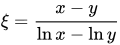
The logarithmic mean is obtained as the value of ξ by substituting ln for f and similarly for its corresponding derivative:
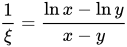
and solving for ξ:
Integration
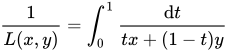
The logarithmic mean is also given by the integral

This interpretation allows the derivation of some properties of the logarithmic mean. Since the exponential function is monotonic, the integral over an interval of length 1 is bounded by x and y.
Two other useful integral representations areand

Generalization
Mean value theorem of differential calculus
One can generalize the mean to n + 1 variables by considering the mean value theorem for divided differences for the n-th derivative of the logarithm.
We obtain where denotes a divided difference of the logarithm. For n = 2 this leads to
![{\displaystyle L_{\text{MV}}(x_{0},\,\dots ,\,x_{n})={\sqrt[{-n}]{(-1)^{n+1}n\ln \left(\left[x_{0},\,\dots ,\,x_{n}\right]\right)}}}](http://wikimedia.org/api/rest_v1/media/math/render/svg/a9b5e9b0e8f2c4330df730196b609e50b66b551e)
![{\displaystyle \ln \left(\left[x_{0},\,\dots ,\,x_{n}\right]\right)}](http://wikimedia.org/api/rest_v1/media/math/render/svg/7456e6367275d5f13829e0150ea009b5b093bb38)

Integral
The integral interpretation can also be generalized to more variables, but it leads to a different result. Given the simplex with and an appropriate measure which assigns the simplex a volume of 1, we obtain


This can be expressed as the divided differences of the exponential function by In the case of n = 2, it is
![{\displaystyle L_{\text{I}}\left(x_{0},\dots ,x_{n}\right)=n!\exp \left[\ln \left(x_{0}\right),\dots ,\ln \left(x_{n}\right)\right].}](http://wikimedia.org/api/rest_v1/media/math/render/svg/5fc753f100a22e757e56bba1a87b5512fa3d29cb)

Connection to other means
Some other means can be expressed in terms of the logarithmic mean.
 ,
,  ...
...| Name | Mean | Expression |
|---|---|---|
| Arithmetic mean | ||
| Geometric mean | ||
| Harmonic mean |


See also
- The logarithmic mean is a special case of the Stolarsky mean.
- Logarithmic mean temperature difference
- Log semiring