Stolarsky mean
From Wikipedia, the free encyclopedia
In mathematics, the Stolarsky mean is a generalization of the logarithmic mean. It was introduced by Kenneth B. Stolarsky in 1975.[1]
For two positive real numbers and the Stolarsky Mean is defined as:


Derivation
It is derived from the mean value theorem, which states that a secant line, cutting the graph of a differentiable function at and , has the same slope as a line tangent to the graph at some point in the interval .


![{\displaystyle [x,y]}](https://wikimedia.org/api/rest_v1/media/math/render/svg/1b7bd6292c6023626c6358bfd3943a031b27d663)
![{\displaystyle \exists \xi \in [x,y]\ f'(\xi )={\frac {f(x)-f(y)}{x-y}}}](https://wikimedia.org/api/rest_v1/media/math/render/svg/de508a525bca5e9fdd9e4f2c66a3b3e7d28b72d0)
The Stolarsky mean is obtained by
![{\displaystyle \xi =\left[f'\right]^{-1}\left({\frac {f(x)-f(y)}{x-y}}\right)}](https://wikimedia.org/api/rest_v1/media/math/render/svg/fa492264dcee6e015611b1969e018608807c26f5)
when choosing .

Special cases
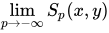
- is the minimum.
- is the geometric mean.
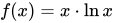
- is the logarithmic mean. It can be obtained from the mean value theorem by choosing .
- is the power mean with exponent .
- is the identric mean. It can be obtained from the mean value theorem by choosing .
- is the arithmetic mean.
- is a connection to the quadratic mean and the geometric mean.
- is the maximum.





![{\displaystyle S_{p}(x_{0},\dots ,x_{n})={f^{(n)}}^{-1}(n!\cdot f[x_{0},\dots ,x_{n}])}](https://wikimedia.org/api/rest_v1/media/math/render/svg/ab361b1e61f4e4bb6d7848763f501b47f20f64c7)