Long Beach Street Circuit
Car racing street circuit in California, US
From Wikipedia, the free encyclopedia
The Long Beach Street Circuit is a street circuit opened in 1975, located in Long Beach in California. The circuit hosts the Grand Prix of Long Beach in championships, such as IndyCar Series, IMSA SportsCar Championship. It also hosted races for Formula One, Formula E, Championship Auto Racing Teams, American Le Mans Series, and Rolex Sports Car Series.

Grand Prix Circuit (2000–present) | |
| Location | Long Beach, California, USA |
|---|---|
| Coordinates | 33°45′59″N 118°11′34″W |
| FIA Grade | 2 |
| Opened | 28 September 1975 |
| Major events | Current: IndyCar Series Grand Prix of Long Beach (1984–2019, 2021–present) IMSA SportsCar Championship Acura Grand Prix of Long Beach (1990–1991, 2006–2019, 2021–present) Stadium Super Trucks (2013–2019, 2021–present) Formula D (2006–2019, 2021–present) Former: Formula E Long Beach ePrix (2015–2016) Formula One United States Grand Prix West (1976–1983) Pirelli World Challenge (2006–2018) Trans-Am Series (1987–1989, 1992–1993, 1996, 1998–2005) North American Touring Car Championship (1997) SCCA/USAC Formula 5000 Championship (1975) |
| Website | https://www.gplb.com/ |
| Grand Prix Circuit (2000–present) | |
| Length | 1.968 mi (3.167 km) |
| Turns | 11 |
| Race lap record | 1:07.2359 ( Álex Palou, Dallara DW12, 2022, IndyCar) Álex Palou, Dallara DW12, 2022, IndyCar) |
| Formula E Circuit (2015–2016) | |
| Length | 1.324 mi (2.131 km) |
| Turns | 7 |
| Race lap record | 0:57.938 ( Sébastien Buemi, Renault Z.E 15, 2016, F-E) Sébastien Buemi, Renault Z.E 15, 2016, F-E) |
| Grand Prix Circuit (1999) | |
| Length | 1.824 mi (2.935 km) |
| Turns | 13 |
| Race lap record | 1:02.779 ( Juan Pablo Montoya, Reynard 99I, 1999, CART) Juan Pablo Montoya, Reynard 99I, 1999, CART) |
| Grand Prix Circuit (1992–1998) | |
| Length | 1.586 mi (2.552 km) |
| Turns | 9 |
| Race lap record | 0:51.333 ( Bobby Rahal, Reynard 98I, 1998, CART) Bobby Rahal, Reynard 98I, 1998, CART) |
| Grand Prix Circuit (1984–1991) | |
| Length | 1.670 mi (2.687 km) |
| Turns | 13 |
| Race lap record | 1:08.5563 ( Mario Andretti, Lola T900, 1985, CART) |
| Grand Prix Circuit (1983) | |
| Length | 2.035 mi (3.275 km) |
| Turns | 18 |
| Race lap record | 1:28.330 ( Niki Lauda, McLaren MP41C, 1983, F1) Niki Lauda, McLaren MP41C, 1983, F1) |
| Grand Prix Circuit (1982) | |
| Length | 2.130 mi (3.428 km) |
| Turns | 14 |
| Race lap record | 1:30.831 ( Niki Lauda, McLaren MP4B, 1982, F1) |
| Grand Prix Circuit (1975–1981) | |
| Length | 2.020 mi (3.251 km) |
| Turns | 13 |
| Race lap record | 1:19.830 ( Nelson Piquet, Brabham BT49, 1980, F1) Nelson Piquet, Brabham BT49, 1980, F1) |
History


.jpg)
The Long Beach Grand Prix was the brainchild of promoter Chris Pook, a former travel agent from England. Pook was inspired by the Monaco Grand Prix, and believed that a similar event had the potential to succeed in the Southern California area. The city of Long Beach was selected, approximately 25 mi (40 km) south of downtown Los Angeles. A waterfront circuit, near the Port of Long Beach was laid out on city streets, and despite the area at the time being mostly a depressed, industrial port city, the first event drew 30,000 fans. The inaugural race was held in September 1975 as part of the Formula 5000 series.[1][2]
In 1976, the United States Grand Prix West was created, providing two grand prix races annually in the United States for a time. Long Beach became a Formula One event for 1976 and the race was moved to March or April. Meanwhile, the United States Grand Prix East at Watkins Glen International was experiencing a noticeably steady decline. Despite gaining a reputation of being demanding and rough on equipment, Long Beach almost immediately gained prominence owing much to its pleasant weather, picturesque setting, and close proximity to Los Angeles and the glitzy Hollywood area.[1][2][3] When Watkins Glen was dropped from the Formula One calendar after 1980, the now-established Long Beach began to assume an even more prominent status.
Despite exciting races and strong attendance, the event was not financially successful as a Formula One event. The promoter was risking a meager $100,000 profit against a $6–7 million budget. Fearing that one poor running could bankrupt the event, Pook convinced city leaders to change the race to a CART Indy car event beginning in 1984. In short time, the event grew to prominence on the Indy car circuit and has been credited with triggering a renaissance in the city of Long Beach. The race was used to market the city, and in the years since the race's inception, many dilapidated and condemned buildings have been replaced with high-rise hotels and tourist attractions.[1][2]
The event served as a CART/Champ Car race from 1984 to 2008, then became an IndyCar Series race event in 2009. The 2017 race was the 43rd running, and the 34th consecutive as an IndyCar race, one of the longest continuously running events in the history of American open-wheel car racing. On three occasions (1984, 1985 and 1987) the race served as the CART season opener. In seven separate seasons (1986, 1988, 1989, 1990, 1992, 1993 and 1994), it served as the final race before the Indianapolis 500.
Due to the COVID-19 pandemic, the 2020 race was canceled as part of the City of Long Beach's ban on events with estimated attendance of more than 250.[4] The following year, as a preparatory measure for the pandemic's effects on the schedule, the race was moved from its traditional April date to September 26, and served as the season finale.[5] With the rise of the Delta variant there were concerns from IndyCar and the event promoters that the race would have to be canceled for 2021 or run with an attendance cap, but the promoters and the city of Long Beach were able to work out a compromise on safety measures and rapid testing to allow the event to go forward with full capacity.[6]
The Grand Prix returned to its traditional April date for the 2022 season.
On March 28, 2024, it was announced that former ChampCar owner Gerald Forsythe would buy a 50% stake in the Long Beach Grand Prix from the estate of the late Kevin Kalkhoven.[7]
Circuit
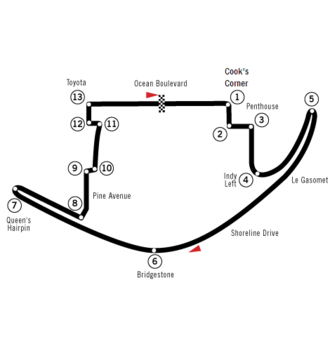
The current race circuit is a 1.968 mi (3.167 km) temporary road course laid out in the city streets surrounding the Long Beach Convention Center. The convention center actually doubled as the pit paddock during the days of Formula One. The circuit also goes primarily over the former location of The Pike historic amusement zone. The track is particularly noted for its last section, a sharp hairpin turn followed by a long, slightly curved front straightaway which runs the length of Shoreline Drive. The circuit is situated on the Long Beach waterfront, and is lined with palm trees (especially along the front straightaway towards the Aquarium of the Pacific), making for a scenic track. Long Beach is classified as an FIA Grade Two circuit.[8]
The circuit has undergone numerous layout changes since the race's inception in 1975. All iterations have featured a signature hairpin turn, main stretch along Shoreline Drive, and back stretch along Seaside Way or Ocean Boulevard. The first grand prix layout measured 2.020 mi (3.251 km), and featured two hairpins, one at each end of the Shoreline Drive straightaway. In its early years, the starting line and the finish line were located on different sides of the course.
In 1982, the hairpin turn and the end of the main stretch (turn 1) was removed, and replaced with a 90-degree right turn, followed by 90-degree left turn. When the race became a CART series event, the layout was changed significantly. The final turn hairpin was moved to the east, closer to the pit entrance. Other slow chicanes and turns were removed. After a minor tweak to the layout in 1987, the track was shortened in 1992 by the removal of the Park Avenue loop. That created a longer Seaside Way back stretch and a faster run to the passing zone.
In 1999, due to new construction in the area, the turn one set of curves was removed, and replaced with the new fountain complex. Turn one now became a 90-degree left turn, leading into a roundabout around a fountain, and a series of three 90-degree turns. A year later, this segment was revised again, to create a longer straightaway leading to Pine Avenue. This course layout remains intact today.
In 2015, a modified 1.324 mi (2.131 km) version of the Grand Prix track was used during the Long Beach ePrix of the FIA Formula E Championship, which featured seven turns. The ePrix was held once again in 2016. In 2017, Formula E went to Brooklyn Street Circuit instead of there.
Layout history
 Grand Prix Circuit (1975–1977)
 Grand Prix Circuit (1978–1981)
 Grand Prix Circuit (1982)
 Grand Prix Circuit (1983)
 Grand Prix Circuit (1984–1986)
 Grand Prix Circuit (1987–1991)
 Grand Prix Circuit (1992–1998)
 Grand Prix Circuit (1999)
 Grand Prix Circuit (2000–present)
 Formula E Circuit (2015–2016)


_compat.svg)
.svg)
.svg)


Winners
IndyCar
IMSA
Events
Current
- April
- IndyCar Series Grand Prix of Long Beach
- IMSA SportsCar Championship Grand Prix of Long Beach
- Formula D
- Porsche Carrera Cup North America
- Stadium Super Trucks
- October
Former
- American Le Mans Series
- American Le Mans Series at Long Beach (2007–2013)
- Atlantic Championship Series (1978–1982, 1989–2008)
- Champ Car World Series
- Grand Prix of Long Beach (1984–2007)
- Formula E
- Long Beach ePrix (2015–2016)
- Formula One
- United States Grand Prix West (1976–1983)
- GT America Series (2024–2025)
- GT4 America Series (2019)
- IMSA GT Championship (1990–1991)
- Indy Lights (1989–2001, 2009–2015)
- North American Touring Car Championship (1997)
- Pirelli World Challenge (2006–2018)
- Rolex Sports Car Series (2006)
- SCCA/USAC Formula 5000 Championship (1975)
- SCCA Formula Super Vee (1983–1988)
- Toyota Pro/Celebrity Race (1977–2016)
- Trans-Am Series (1987–1989, 1992–1993, 1996, 1998–2005)
Lap records
The unofficial track record is 1:05.3095, set by Colton Herta in a Dallara DW12, during qualifying for the 2022 Acura Grand Prix of Long Beach.[9] As of April 2026, the fastest official race lap records at the Long Beach Street Circuit are listed as:

