Low thrust relative orbital transfer
From Wikipedia, the free encyclopedia
In orbital mechanics, low-thrust relative transfer is an orbital maneuver in which a chaser spacecraft covers a specific relative distance relative to the target spacecraft using continuous low-thrust system, typically with a high specific impulse.[1] This is in contrast to conventional impulsive transfers in the orbit which use thermal rocket engines. Such transfers use low-thrust propulsion systems such as electrically powered spacecraft propulsion and solar sails.
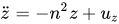
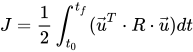
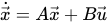
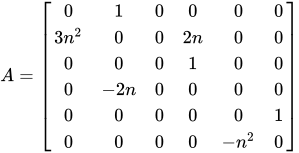
Low-thrust relative transfers use the orbital relative motion equations. These are the non-linear equations that describe the motion of the chaser spacecraft relative to the target in terms of displacements along the respective axis of the accelerated frame of reference fixed on the target spacecraft. In 1960, W. H. Clohessy and R. S. Wiltshire published the Clohessy-Wiltshire equations,[2] which present a simplified model of orbital relative motion, in which the target is in a circular orbit, and the chaser spacecraft is in an elliptical or circular orbit. Since the magnitude of the available thrust is limited, the transfer is occasionally posed as an optimal control problem subjected to the required objective and constraints.
Relative orbital motion refers to the motion of one spacecraft relative to another spacecraft orbiting the same planet. There can be one primary spacecraft known as the target and the other spacecraft (the chaser) tasked with performing the required maneuver relative to the target. Based on the mission requirements, the various relative orbital transfers can be rendezvous and docking operations, and maintaining station relative to the target. Unlike using a thrust impulse to near-instantaneously change the velocity of the spacecraft, in non-impulsive transfers, there is a continuous application of thrust, so that the spacecraft changes its orbit gradually. Non-impulsive transfers rely on low-thrust propulsion for the operations. Some notable low-thrust propulsion methods are ion propulsion, Hall-effect thrusters, and solar-sail systems.