Loxanthocereus acanthurus
From Wikipedia, the free encyclopedia
| Loxanthocereus acanthurus | |
|---|---|
 | |
Scientific classification  | |
| Kingdom: | Plantae |
| Clade: | Tracheophytes |
| Clade: | Angiosperms |
| Clade: | Eudicots |
| Order: | Caryophyllales |
| Family: | Cactaceae |
| Subfamily: | Cactoideae |
| Genus: | Loxanthocereus |
| Species: | L. acanthurus |
| Binomial name | |
| Loxanthocereus acanthurus (Vaupel) Backeb. 1937 | |
| Synonyms | |
| |
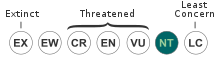
Loxanthocereus acanthurus is a species of Loxanthocereus found in Peru.[2]
Loxanthocereus acanthurus grows shrubby with prostrate to creeping, ascending or hanging, up to 30 centimeters (rarely up to 50 centimeters) long shoots that have a diameter of 2-5 centimeters. There are 15-18 low, rounded ribs divided by sharp indentations into indistinct protuberances. The 2-5 (rarely up to 6) central spines are yellowish and up to 1.5 centimeters long. They are difficult to distinguish from the 20-40 short, thin, yellowish radial spines.
The straight or slightly curved, crooked, scarlet flowers are 4 to 9.5 inches long. The spherical fruits reach a diameter of 2 to 2.5 centimeters.[3]
Subspecies
There are two recognized subspecies:[2]
| Image | Name | Distribution |
|---|---|---|
 | Loxanthocereus acanthurus subsp. acanthurus | Peru |
 | Loxanthocereus acanthurus subsp. pullatus (Rauh & Backeb.) Ostolaza | Peru |

