Lydersen method
From Wikipedia, the free encyclopedia
The Lydersen method is a group contribution method for the estimation of critical properties temperature (Tc), pressure (Pc) and volume (Vc). The method is named after Aksel Lydersen who published it in 1955.[1] The Lydersen method is the prototype for and ancestor of many new models like Joback,[2] Klincewicz,[3] Ambrose,[4] Gani-Constantinou[5] and others.
The Lydersen method is based in case of the critical temperature on the Guldberg rule which establishes a relation between the normal boiling point and the critical temperature.
Critical temperature
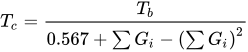
Guldberg has found that a rough estimate of the normal boiling point Tb, when expressed in kelvins (i.e., as an absolute temperature), is approximately two-thirds of the critical temperature Tc. Lydersen uses this basic idea but calculates more accurate values.
Critical pressure
Critical volume
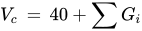
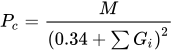
M is the molar mass and Gi are the group contributions (different for all three properties) for functional groups of a molecule.
