Lévy-Leblond equation
From Wikipedia, the free encyclopedia
In quantum mechanics, the Lévy-Leblond equation describes the dynamics of a spin-1/2 particle. It is a linearized version of the Schrödinger equation and of the Pauli equation. It was derived by French physicist Jean-Marc Lévy-Leblond in 1967.[1]
The Lévy-Leblond equation was obtained under similar heuristic derivations as the Dirac equation, but contrary to the latter, the Lévy-Leblond equation is not relativistic. As both equations recover the electron gyromagnetic ratio, it is suggested that spin is not necessarily a relativistic phenomenon.
For a nonrelativistic spin-1/2 particle of mass m, a representation of the time-independent Lévy-Leblond equation reads:[1]
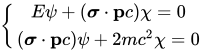
where c is the speed of light, E is the nonrelativistic particle energy, is the momentum operator, and is the vector of Pauli matrices, which is proportional to the spin operator . Here are two-component functions (spinors) describing the wave function of the particle.




By minimal coupling, the equation can be modified to account for the presence of an electromagnetic field,[1]
![{\displaystyle \left\{{\begin{matrix}(E-qV)\psi +[{\boldsymbol {\sigma }}\cdot (\mathbf {p} -q\mathbf {A} )c]\chi =0\\{[{\boldsymbol {\sigma }}\cdot (\mathbf {p} -q\mathbf {A} )c]}\psi +2mc^{2}\chi =0\end{matrix}}\right.}](https://wikimedia.org/api/rest_v1/media/math/render/svg/03b267b2190efbb1b5c9ea16962d2d1d6d959762)
where q is the electric charge of the particle. V is the electric potential, and A is the magnetic vector potential. This equation is linear in its spatial derivatives.
Relation to spin
In 1928, Paul Dirac linearized the relativistic dispersion relation and obtained what is now called the Dirac equation, described by a Dirac spinor. This equation can be decoupled into two spinors in the non-relativistic limit, providing an explanation of the electron magnetic moment with a gyromagnetic ratio .[2] This success of Dirac theory has led some textbooks to erroneously claim that spin is necessarily a relativistic phenomena.[3][4]

Jean-Marc Lévy-Leblond applied the same technique to the non-relativistic energy relation showing that the same prediction of can be obtained.[2] In fact, to derive the Pauli equation from the Dirac equation one has to pass by the Lévy-Leblond equation.[2] Spin is then a result of quantum mechanics and linearization of the equations, but not necessarily a relativistic effect.[3][5]
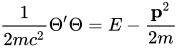
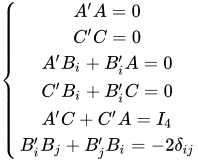
The Lévy-Leblond equation is Galilean invariant. This equation demonstrates that one does not need the full Poincaré group to explain some properties of spin 1/2 systems.[4] In the classical limit where , quantum mechanics under the Galilean transformation group are enough.[1] Similarly, one can construct a non-relativistic linear equation for any arbitrary spin.[1][6] Under the same idea one can construct equations for Galilean electromagnetism.[1]

![{\displaystyle {\frac {1}{2m}}({\boldsymbol {\sigma }}\cdot \mathbf {p} )^{2}\psi -E\psi =\left[{\frac {1}{2m}}\mathbf {p} ^{2}-E\right]\psi =0}](https://wikimedia.org/api/rest_v1/media/math/render/svg/729eb7c0de1794aeec2cb55e67abc796d5f77cb1)

![{\displaystyle \left\{{\frac {1}{2m}}[{\boldsymbol {\sigma }}\cdot (\mathbf {p} -q\mathbf {A} )]^{2}+qV\right\}\psi =E\psi }](https://wikimedia.org/api/rest_v1/media/math/render/svg/98381e5340ef99729e7b8361ec3fcc9e1c6599cf)
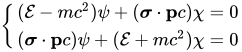





![{\displaystyle \left\{{\begin{matrix}\Theta \Psi =[AE+\mathbf {B} \cdot \mathbf {p} c+2mc^{2}C]\Psi =0\\\Theta '\Psi =[A'E+\mathbf {B} '\cdot \mathbf {p} c+2mc^{2}C']\Psi =0\end{matrix}}\right.}](https://wikimedia.org/api/rest_v1/media/math/render/svg/22f63e8ce6902501aca9b33344c8358a67ec9563)