Magnolia silvioi
From Wikipedia, the free encyclopedia
| Magnolia silvioi | |
|---|---|
 | |
Scientific classification  | |
| Kingdom: | Plantae |
| Clade: | Tracheophytes |
| Clade: | Angiosperms |
| Clade: | Magnoliids |
| Order: | Magnoliales |
| Family: | Magnoliaceae |
| Genus: | Magnolia |
| Section: | Magnolia sect. Talauma |
| Species: | M. silvioi |
| Binomial name | |
| Magnolia silvioi (Lozano) Govaerts | |
| Synonyms | |
|
Talauma silvioi Lozano | |
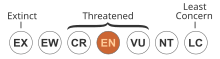
Magnolia silvioi is an endemic species of Antioquia department. Common names include: guanábano de monte, fruta de molinillo, guanabanillo.
They are trees reaching up to 35 m height and 100 cm in diameter. Leaves alternate, simple, spirally arranged, coriaceous, elliptic, measuring from 11 to 26 cm long and from 7,4 to 12 cm wide; petiole greatly thickened at the base and present a scar that cover it completely. Flowers have cream color, two bracts up to 5 cm long covering the flower bud; three sepals and seven petals. The fruits are subglobose to ovoid, large, up to 16 cm long; 1-2 seeds per carpel with red cover.[1][2]
Distribution and habitat


This is an endemic species of Antioquia department. It is distributed in Central Andes in two regions in Northeast and East of the department in the medium valley of Magdalena River. The altitudinal range goes from 400 to 1’550 m.[2]