Maihuenia patagonica
From Wikipedia, the free encyclopedia
| Maihuenia patagonica | |
|---|---|
.jpg) | |
Scientific classification  | |
| Kingdom: | Plantae |
| Clade: | Tracheophytes |
| Clade: | Angiosperms |
| Clade: | Eudicots |
| Order: | Caryophyllales |
| Family: | Cactaceae |
| Genus: | Maihuenia |
| Species: | M. patagonica |
| Binomial name | |
| Maihuenia patagonica Phil. Britton & Rose | |
| Synonyms[2] | |
| |

Maihuenia patagonica, commonly known locally as chupasangre or siempre verde, is a succulent cactus shrub native to Chile and Argentina. Maihuenia patagonica is remarkably tolerant to moisture and cold temperatures.[3]
Maihuenia patagonica forms dense cushions about 30–40 cm (12–16 in) tall and 3 meters in diameter with densely-packed spines. It has a single, 40 cm (16 in) long taproot. The elongated shoots are not segmented and are loosely arranged. They are up to 40 centimeters long and have a diameter of 1 to 2 centimeters. There are numerous button-like to cylindrical, spur-like short shoots. The numerous green leaves are conical, ovoid or linear and circular to elliptical in cross section. They are 2 to 6 millimeters long and 1.5 to 3 millimeters in diameter. The single, stiff central spine is 3 to 7.5 centimeters long. The 2 marginal thorns (rarely only one or completely missing) are sometimes inconspicuous, sometimes lie on the surface of the shoot and are 2 to 8 millimeters long.
It blooms white to violet flowers usually appear terminally on short shoots. The elongated to almost spherical to club-shaped fruits are 2 to 4 centimeters long.[4]
The chromosome count is 2n = 22[5]
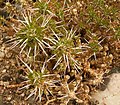 Plants
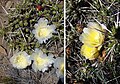 white flowers

.jpg)
Distribution
Maihuenia patagonica is widespread in southern Argentina and Chile at altitudes of up to 500 meters.

