Malapardis, New Jersey
From Wikipedia, the free encyclopedia
Malapardis, New Jersey | |
|---|---|
Unincorporated community | |
 Malapardis Park in 2006 | |
 Interactive map of Malapardis, New Jersey | |
| Coordinates: 40°49′46″N 74°25′55″W / 40.8295441°N 74.4318200°W[1] | |
| Country | United States |
| State | New Jersey |
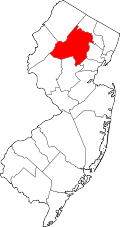
| County | Morris |
| Township | Hanover |
| Elevation | 269 ft (82 m) |
| ZIP Code | 07981 |
| Area code | 973, 862 |
Malapardis is an unincorporated community located within Hanover Township, New Jersey, United States.[1][2][3][4]
Malapardis was settled sometime in 1735. The name is derived from the Lenape word “Malapahus” which means “place of the poor flint.”[5] The first settlement in Malapardis was located along Stony Brook.[6] It formerly had a woolen mill and iron forge, but has since been redeveloped.[2][7][8]
The forge at Malapardis was established sometime between 1750 and the American Revolutionary War.[9] At that time, the roads were so poor that the iron for the forges was brought in by horseback, as wagons could not be used.[10]
Another early building was the carding and fulling mill founded by Abraham Fairchild in 1810; Fairchild brought in machines from the New York State Prison. This building was later replaced on the same site by the wool mill established by G.R. Fairchild.[9] Among the other historic buildings was the Stony Brook Mill, which was built in the late 1890s. This building was torn down in the 1980s.[11]
In 1820, a school district for Malapardis was established. This was numbered New Jersey School District #86.[4] In the 1920s, three schools operated in Malapardis.[12] The Malapardis School was converted to the Hannover Township municipal building in the 1950s.[11] The old wooden Malapardis schoolhouse was turned into the rectory for the Saint John the Baptist Ukrainian Catholic Church.[13] This church was established near Malapardis Creek by Ukrainians in 1921.[14] These buildings are now part of Whippany.[13]
In 1905, traces of an old Native American settlement were still visible between Malapardis and nearby Littleton, to the west.[15]
As the population of New Jersey grew, community boundaries shifted, and Malapardis "receded", according to one author.[16] Malapardis and Whippany had been established in the 1700s, two centuries before Cedar Knolls, which was established to the west of Malapardis in 1913.[17] When Whippany and Cedar Knolls were established as Census Designated Places, their boundaries were established at Interstate 287.[18][19] A number of sources thus call Malapardis a "former village" or "once thriving" community.[16][20]