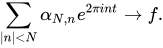
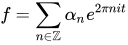
Conventionally, if the index is  , then it means the index set is countable. Otherwise, if the index is
  , then it means the index set is not necessarily countable.
Let  be Banach space. A biorthogonal system
  in is a Markushevich basis if
  is complete (also called "fundamental"):
 and
and  is total: it separates the points of . Totality is equivalently stated as
  where the closure is taken under the weak-star topology.
A Markushevich basis is shrinking iff we further have under the topology induced by the operator norm on  .
.
A Markushevich basis is bounded iff  .
.
A Markushevich basis  is strong iff
  for all
  .
.
Since  , we always have the lower bound
  , and therefore
 ![{\displaystyle \sup _{i}\|x_{i}\|\|x_{i}^{*}\|\in [1,\infty ]}](https://wikimedia.org/api/rest_v1/media/math/render/svg/e742f33add60dd0c3b441d33aa954f06753ce9ba) .
.
If  , then we can simply scale both so that
  for all . This special case of the Markushevich basis is called an Auerbach basis. Auerbach's lemma states that any finite-dimensional Banach space has an Auerbach basis.



![{\displaystyle {\tilde {C}}[0,1]}](https://wikimedia.org/api/rest_v1/media/math/render/svg/c1e8d857708c5609e1a3c3fc215b24b6ebba31be)
![{\displaystyle [0,1]}](https://wikimedia.org/api/rest_v1/media/math/render/svg/738f7d23bb2d9642bab520020873cccbef49768d)
![{\displaystyle f\in {\tilde {C}}[0,1]}](https://wikimedia.org/api/rest_v1/media/math/render/svg/a23131d264d139c4b8274510b29021a4c2442969)