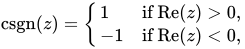
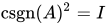
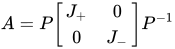
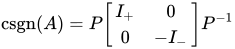
Theorem:[2][3] Let  and assume that
  and
and  are stable, then the unique solution to the Sylvester equation,
  , is given by
  such that

Proof sketch: The result follows from the similarity transform

since

due to the stability of and .
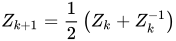
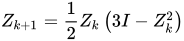
The theorem is, naturally, also applicable to the Lyapunov equation. However, due to the structure the Newton iteration simplifies to only involving inverses of and  .
.
There is a similar result applicable to the algebraic Riccati equation,  .[1][2] Define
 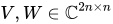 as
as

Under the assumption that 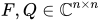 are Hermitian and there exists a unique stabilizing solution, in the sense that
  is stable, that solution is given by the over-determined, but consistent, linear system

Proof sketch: The similarity transform

and the stability of implies that

for some matrix  .
.
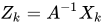
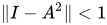
The Denman–Beavers iteration for the square root of a matrix can be derived from the Newton iteration for the matrix sign function by noticing that  is a degenerate algebraic Riccati equation[3] and by definition a solution
  is the square root of .