Matroid parity problem
From Wikipedia, the free encyclopedia

In combinatorial optimization, the matroid parity problem is a problem of finding the largest independent set of paired elements in a matroid, a structure that abstracts and generalizes the notion of linear independence in vector spaces. The problem was formulated by Lawler (1976) as a common generalization of graph matching and matroid intersection. It is also known as polymatroid matching, or the matchoid problem.[1]
Matroid parity can be solved in polynomial time for linear matroids. However, it is NP-hard for certain compactly-represented matroids, and requires more than a polynomial number of steps in the matroid oracle model.
Applications of matroid parity algorithms include finding large planar subgraphs and finding graph embeddings of maximum genus. Matroid parity algorithms can also be used to find connected vertex covers and feedback vertex sets in graphs of maximum degree three.
A matroid can be defined from a finite set of elements and from a nonempty family of independent sets, subject to the following constraints:
- Every subset of an independent set must be independent.
- If and are independent sets, with , then there exists an element such that is independent.[2]


Examples of matroids include the linear matroids (in which the elements are vectors in a vector space, with linear independence), the graphic matroids (in which the elements are edges in an undirected graph, independent when they contain no cycle), and the partition matroids (in which the elements belong to a family of disjoint sets, and are independent when they contain at most one element in each set). Graphic matroids and partition matroids are special cases of linear matroids.[2]
In the matroid parity problem, the input consists of a matroid together with a pairing on its elements, so that each element belongs to one pair. The goal is to find a subset of the pairs, as large as possible, so that the union of the pairs in the chosen subset is independent.[2][3] In another seemingly more general variation, the allowable pairs form a graph rather than having only one pair per element, and the goal is to find as many disjoint pairs as possible so that their union is independent. However, this variation is equivalent: If an element appears in more than one pair, one could modify the matroid by making multiple copies of that element, with only one copy allowed in an independent set, and use different copies of the element in different pairs. Repeating this replacement for all elements that appear in more than one pair would produce a equivalent instance of the matroid parity problem with each element belonging to only one pair.[4]
This problem was originally formulated in 1976 by Eugene Lawler. It generalized two previously-studied problems, graph matching and matroid intersection (see § Applications).[2][3]
Algorithms
The matroid parity problem for linear matroids can be solved by a randomized algorithm in time , where is the number of elements of the matroid, is its rank (the size of the largest independent set), and is the exponent in the time bounds for fast matrix multiplication.[2] In particular, using a matrix multiplication algorithm of Virginia Vassilevska Williams et al.,[5] it can be solved in time . Without using fast matrix multiplication, the linear matroid parity problem can be solved in time .[2] For instances with real numbers assigned as the weights of each element, it is also possible to find a minimum-weight solution to the matroid parity problem, or a maximum-weight paired independent set, in linear matroids, in time .[6]


These algorithms are based on a linear algebra formulation of the problem by Geelen & Iwata (2005). Suppose that an input to the problem consists of pairs of -dimensional vectors (arranged as column vectors in a matrix of size ). Then the number of pairs in the optimal solution is


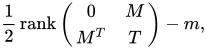
where is a block diagonal matrix whose blocks are submatrices of the form


for a sequence of variables .[7] The Schwartz–Zippel lemma can be used to test whether this matrix has full rank or not (that is, whether the solution has size or not), by assigning random values to the variables and testing whether the resulting matrix has determinant zero. By applying a greedy algorithm that removes pairs one at a time by setting their variables to zero as long as the matrix remains of full rank (maintaining the inverse matrix using the Sherman–Morrison formula to check the rank after each removal), one can find a solution whenever this test shows that it exists. Additional methods extend this algorithm to the case that the optimal solution to the matroid parity problem has fewer than pairs.[2]


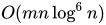
For graphic matroids, more efficient matroid parity algorithms are known, based on range searching data structures, with running time on graphs with vertices and edges.[8] For simple graphs, is , but for multigraphs, it may be larger, so it is also of interest to have algorithms with smaller or no dependence on and worse dependence on . In these cases, it is also possible to solve the graphic matroid parity problem in randomized expected time , or in time when each pair of edges forms a path.[2]


The matroid parity problem is NP-hard for certain compactly-represented matroids. Additionally, it requires more than a polynomial number of steps in the matroid oracle model, in which an algorithm is given access to an arbitrary matroid only through a subroutine that determines whether a given set is independent.[2][9] Nevertheless, in these cases, it can still be approximated efficiently. Simple local search algorithms provide a polynomial-time approximation scheme for this problem, and find solutions whose size, as a fraction of the optimal solution size, is arbitrarily close to one. The algorithm starts with the empty set as its solution, and repeatedly attempts to increase the solution size by one by removing at most a constant number of pairs from the solution and replacing them by a different set with one more pair. When no more such moves are possible, the resulting solution is returned as the approximation to the optimal solution. To achieve an approximation ratio of , it suffices to choose to be approximately .[4]


