May 11 (Eastern Orthodox liturgics)
Day in the Eastern Orthodox liturgical calendar
From Wikipedia, the free encyclopedia
May 10 â Eastern Orthodox Church calendar â May 12

All fixed commemorations below celebrated on May 24 by Orthodox Churches on the Old Calendar.[note 1]
For May 11th, Orthodox Churches on the Old Calendar commemorate the Saints listed on April 28.
Saints
- Martyr Evellius, under Nero (66)[1][2]
- Martyrs Maximus, Bassus, and Fabius (284â305)[2][3]
- Hieromartyr Mocius (Mucius), presbyter of Amphipolis in Macedonia, beheaded in Byzantium (288)[4][5]
- Martyr Armodius.[6][note 2]
- Saints Cyril and Methodius, Equal-to-the-Apostles and Enlighteners of the Slavs (869, 885)[4][7][8] (see also: July 17 )
- Saints Clement of Ohrid (916), Sabbas (10th century), Angelarius (Angelyar) (c. 886), Gorazd (896), and Naum of Preslav (910) â Disciples of Saints Cyril and Methodius and missionaries of the Slavs, Wonderworkers and Equal-to-the-Apostles.[9] (see also: July 27 )
- Saint Rostislav the Prince of Greater Moravia, Confessor of the Faith and Equal-to-the-Apostles (870)[4][8][10] (see also: October 29)
Pre-Schism Western saints
- Hieromartyr Anthimus of Rome, and martyrs Sisinius the deacon with Diocletius and Florentius (disciples of St. Anthimus), (284â305)[2][11][12]
- Saint Principia of Rome, a holy virgin in Rome and disciple of St Marcella (420)[12]
- Saint Mammertus, Archbishop of Vienne (475)[12][13][14]
- Saint Possessor of Verdun, Bishop of Verdun, he and his flock were greatly troubled by the barbarian invasions of Franks, Vandals and Goths (c. 486)[12]
- Saint Tudy (Tudinus, Tegwin, Thetgo), a disciple of St Brioc in Brittany (5th century)[12]
- Saint Credan of Cornwall, hogherd.[15]
- Saint Gangulphus (760)[12][16]
- Saint Fremund of Dunstable, Anglo-Saxon hermit, killed by his kinsman Oswy with the help of Danish invaders who had also murdered King Edmund (866)[12][17]
- Saint Odo of Cluny, the second Abbot of Cluny (942)[12]
- Saint Mayeul (Majolus, Maieul), Abbot of Cluny (994)[4][12][18]
- Saint Odilo of Cluny (1049)[12]
Post-Schism Orthodox saints
- Martyrs Olympia, Abbess of Mytilene, and nun Euphrosyne (1235)[4][19][20]
- Saint Sophronius of the Kiev Caves, recluse (13th century)[4][21][22][note 3]
- Saint Nicodemus of Pec, Archbishop of Serbia (1324)[4][23]
- Hieromartyr Joseph, first Metropolitan of Astrakhan (1672)[4][24][25][note 4]
- Blessed Christopher of Georgia (Christesias), monk at the Monastery of St. John the Baptist, at the David Gareja monastery complex, "The Thebaid of Georgia" (1771)[4][26][27]
- New Martyr Dioscorus (Dioscorides) the New, of Smyrna, by beheading.[4][28][29]
- New Martyr Argyrus (Argyrus, Argyres) of Thessalonica (1806)[4][29][30]
- Saint Theophylact, Bishop of Stavropol and Ekaterinodar (1872)[4][31]
- Venerable Saint Dionisie (Ignat) of Mount Athos, who lived at the Holy Cell of St. George at Kolitsou, under Vatopedi Monastery (2004)[32][33][note 5][note 6]
New martyrs and confessors
Other commemorations
- Commemoration of the Founding of Constantinople as Capital of the Roman Empire (330)[4][37][38]
- Consecration of the first Saint Sophia Cathedral in Kiev, erected by Princess Olga (960)[39][40]
- "Chelnsk" Icon of the Most Holy Theotokos.[4]
Icon gallery
 Hieromartyr Mocius, Presbyter of Amphipolis.
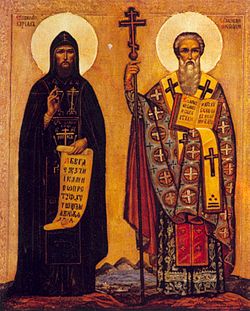 Saints Saints Cyril and Methodius, Equals-to-the-Apostles.
 The Seven Apostles.
 St. Clement of Ohrid.
 Saint Naum of Preslav.
 St. Rostislav the Prince of Great Moravia, Confessor of the Faith.
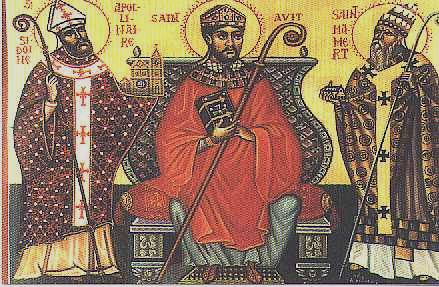 St. Mamertus, Archbishop of Vienne (right).
 St. Gangulphus of Burgundy.
 St. Odo of Cluny.
 St. Majolus of Cluny.
 Hieromartyr Joseph, first Metropolitan of Astrakhan.
 New Hieromartyr Alexander (Petrovsky), Abp. of Kharkov.
 New Hieromartyr Alexander (Petrovsky), Abp. of Kharkov.
_-_South_ceiling_-_detail_01_(S.Mocius).jpg)


.jpg)


.jpg)
Notes
- The notation Old Style or (OS) is sometimes used to indicate a date in the Julian Calendar (which is used by churches on the "Old Calendar").
The notation New Style or (NS), indicates a date in the Revised Julian calendar (which is used by churches on the "New Calendar"). - The Holy martyr Armodius is unknown in the Synaxaristes and Menaia, however his memory is preserved in an 11th-century codex from the Abbey of Santa Maria di Grottaferrata (Greek: μονá¿Ï ÎÏÏ ÏÏοÏÎÏÏηÏ) near Rome.
- See: (in Russian) ÐоÑÐ¸Ñ (миÑÑÐ¾Ð¿Ð¾Ð»Ð¸Ñ ÐÑÑÑÐ°Ñ Ð°Ð½Ñкий). Ðикипедии. (Russian Wikipedia).
- He was glorified by the Ecumenical Patriarchate on August 31, 2025. The official communiqué of the Ecumenical Patriarchate was as follows:
(in Greek) "á¼ÏίÏÎ·Ï á¼ÏεÏάÏιÏεν á½Î¼Î¿ÏÏνÏÏ, εἰÏηγήÏει Ïá¿Ï Îανονικá¿Ï á¼ÏιÏÏοÏá¿Ï, Ïήν καÏάÏαξιν Îµá¼°Ï ÏÏ á¼Î³Î¹Î¿Î»Ïγιον Ïá¿Ï á¼ÎºÎºÎ»Î·ÏÎ¯Î±Ï Ïῶν á¼Î½ á¼Î¸Ïνι á¼ÏκηÏάνÏÏν á½Ïιακá¿Ï βιοÏá¿Ï ÎÎ¹Î¿Î½Ï ÏÎ¯Î¿Ï ÎαÏοÏαιδινοῦ, Ïοῦ á¼Î½ Ïá¿· ἹεÏá¿· Îελλίῳ á¼Î³Î¯Î¿Ï ÎεÏÏÎ³Î¯Î¿Ï ÎολιÏÏοῦ, καί ΠεÏÏÏÎ½Î¯Î¿Ï á¼¹ÎµÏομονάÏÎ¿Ï , ÎÎ¹ÎºÎ±Î¯Î¿Ï Ïá¿Ï ἹεÏá¾¶Ï Î£ÎºÎ®ÏÎ·Ï Î¤Î¹Î¼Î¯Î¿Ï Î ÏοδÏÏÎ¼Î¿Ï , Ïá¿Ï ἹεÏá¾¶Ï Îονá¿Ï ÎεγίÏÏÎ·Ï ÎαÏÏαÏ, Ïá¿Ï Î¼Î½Î®Î¼Î·Ï Î±á½Ïῶν ÏÎµÎ»Î¿Ï Î¼ÎÎ½Î·Ï Ïοῦ μÎν ÏÏÏÏÎ¿Ï , Ïá¿ 11á¿ ÎαÎÎ¿Ï , Ïοῦ Î´Î Î´ÎµÏ ÏÎÏÎ¿Ï , Ïá¿ 24ῠΦεβÏÎ¿Ï Î±ÏÎ¯Î¿Ï á¼ÎºÎ¬ÏÏÎ¿Ï á¼ÏÎ¿Ï Ï."[33]
- See: (in Romanian) Dionisie Ignat. Wikipedia. (Romanian Wikipedia).
- See: (in Russian) ÐлекÑÐ°Ð½Ð´Ñ (ÐеÑÑовÑкий). Ðикипедии. (Russian Wikipedia).