May 13 (Eastern Orthodox liturgics)
Day in the Eastern Orthodox liturgical calendar
From Wikipedia, the free encyclopedia
May 12 - Eastern Orthodox Church calendar - May 14

All fixed commemorations below celebrated on May 26 by Orthodox Churches on the Old Calendar.[note 1]
For May 13th, Orthodox Churches on the Old Calendar commemorate the Saints listed on April 30.
Saints
- Virgin-martyr Glyceria at Heraclea, Propontis (c. 138-161)[1][2][3][4]
- Martyr Laodicius, jailer of Saint Glyceria (c. 138-161)[1][5][6]
- Saint Theoctistus, monk from Tekoa, Palestine.[7][note 2]
- Saint Pausicacus, Bishop of Synnada (606)[1][12]
- Saint Nicephoros, Presbyter of the monastery of Ephapsios.[1][13][note 3]
- Saint Sergius (George) the Confessor of Constantinople, with his wife Irene and children (c. 829-842)[1][14][15]
- Saint Euthymius the New (the Illuminator) (1028),[1][16] founder of Iveron Monastery, and his fellow Georgian saints of Mount Athos:
- His father monk-martyr John of Iveron (998);[1][17] his cousin monk-martyr George of Iveron (1065);[1][18] and monk-martyr Gabriel of Iveron (10th century)[1][19]
Pre-Schism Western saints
- Saint Abbán of Ireland, baptized in 165 AD, missionary in Abingdon, Oxfordshire (2nd century)[20][21]
- Martyr Alexander of Rome (284-305)[1][22][23]
- Saint Valerian of Auxerre, third Bishop of Auxerre in France, and defender of Orthodoxy against Arianism. (350)[24][25]
- Saint Onesimus of Gaul, fifth Bishop of Soissons in France (361)[25][26]
- Saint Servatius, Bishop of Tongres, defender against Arianism in the Netherlands (384)[1][3][25][27][28]
- Saint Agnes of Poitiers, chosen by St. Radegund to be Abbess of Holy Cross at Poitiers in France (588)[25]
- Saint Mael (Mahel), Ascetic on the Isle of Bardsey (6th century)[25]
- Saint Natalis (Natale), Bishop of Milan in Italy (751)[25]
- Saint Anno (Hanno, Annon), Bishop of Verona in Italy (780)[25]
- Saint Merwenna of Rumsey (Merwinna, Merewenna), first Abbess of Rumsey convent, in Hampshire (c. 970)[29][30][note 4] (see also: February 10)
- Blessed Fortis Gabrielli, Ascetic (1040)[25]
Post-Schism Orthodox saints
- Saint Euthymius, Patriarch of Jerusalem (1084)[1]
- Venerable monk-martyrs of Iveron Monastery, martyred by the Latins (c. 1259-1280)[1][31][32][note 5]
- Saint Macarius, Abbot of Glushitsa Monastery, Vologda (1480)[1][33][34][note 6]
- Righteous Virgin Glyceria of Novgorod (1522)[1][35][note 7]
- Blessed Ana, mother of St. Basil of Ostrog (17th c.)[36][37][note 8]
- Saint Euphrosynus of Iveron (18th century)[1][39]
New martyrs and confessors
- Hieromartyrs Basil Sokolov,[note 9] Alexander Zaozersky,[note 10] and Christopher Nadezhdin, Archpriests (1922)[1][34][40]
- Hieromartyr Macarius Telegin, Hieromonk (1922)[1][34][40][note 11]
- Martyr Sergius Tikhomirov, of Moscow (1922)[1][34][40][41]
- Synaxis of the 103 New Hieromartyrs of Cherkasy (20th century)[1][34][40][42]
Other commemorations
- Consecration of the Monastery of Panagia Pantanassa (Most-Holy Queen of All), on the small island of Hagia Glykeria (Incirli Adasi, in the Bay of Tuzla) (12th century)[43]
- Translation of the relics (1688) of Hieromartyr Saint Macarius, Archimandrite of Ovruch and Pinsk, from Kaniv to Pereyaslavl (1678)[1][34][44][45][note 12]
- Birth of righteous Priest Alexis of Bortsurmany, disciple of St. Seraphim of Sarov (1762; â 1848).[46]
- Repose of Rassophore Monk John, of St. Nilus of Sora Monastery (1863)[1]
- Repose of Eldress Sepfora of Klykovo (1997)[1]
Icon gallery
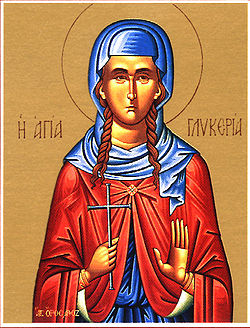 St. Glyceria.
 St. Pausicacus, Bishop of Synnada.
 St. George the Hagiorite.
 Martyr Alexander of Rome.
 St. Servatius, Bishop of Tongres.
 St. Agnes of Poitiers.
 Righteous Virgin Glyceria of Novgorod (center).
 Hieromartyr Basil Sokolov, Archpriest.
 Hieromartyr Macarius Telegin, Hieromonk.


.JPG)
.JPG)


.jpg)
Notes
- The notation Old Style or (OS) is sometimes used to indicate a date in the Julian Calendar (which is used by churches on the "Old Calendar").
The notation New Style or (NS), indicates a date in the Revised Julian calendar (which is used by churches on the "New Calendar"). - The Codex Athous Lavrensis (8th/9th century) states that St, Nicephorus was the Igumen of the Monastery of Ephapsios, and reposed in peace.[13]
- The Crusaders demanded that the Iveron monks convert to Catholicism and acknowledge the primacy of the Roman pope. But the monks condemned their fallacies and anathematized the doctrine of the Catholics. According to the Patericon of Athos, the Iveron monks were forcibly expelled from their monastery. Nearly two hundred elderly monks were goaded like animals onto a ship that was subsequently sunk in the depths of the sea. The younger, healthier monks were deported to Italy and sold as slaves to the Jews. Some sources claim this tragedy took place in the year 1259, while others record that the Georgian monks of the Holy Mountain were subject to the Latin persecutions over the course of four years, from 1276 to 1280.[32]
- See: The Monk Makarii of Glushitsk. HOLY TRINITY RUSSIAN ORTHODOX CHURCH (A parish of the Patriarchate of Moscow).
- See: (in Russian) ÐликеÑÐ¸Ñ ÐовгоÑодÑкаÑ. Ðикипедии. (Russian Wikipedia).
- Saint Ana (Anastasia) (16thâ17th c.) of Popovo Polje, a widow from the VasojeviÄ tribe, was the virtuous and deeply pious mother of St. Basil of Ostrog who experienced miraculous appearances of the Most Holy Theotokos, practiced constant prayer and humility, and assisted the elderly and sick in her community.[38]
- See: (in Russian) Соколов, ÐаÑилий ÐлекÑандÑÐ¾Ð²Ð¸Ñ (ÑвÑÑенномÑÑеник). Ðикипедии. (Russian Wikipedia).
- See: (in Russian) ÐаозеÑÑкий, ÐлекÑÐ°Ð½Ð´Ñ ÐиколаевиÑ. Ðикипедии. (Russian Wikipedia).
- See: (in Russian) ÐакаÑий (Телегин). Ðикипедии. (Russian Wikipedia).
- See: Transferred the Relics of the MonkMartyr Makarii, Archimandrite of Kanevsk. HOLY TRINITY RUSSIAN ORTHODOX CHURCH (A parish of the Patriarchate of Moscow).