May 4 (Eastern Orthodox liturgics)
Day in the Eastern Orthodox liturgical calendar
From Wikipedia, the free encyclopedia
May 3 - Eastern Orthodox Church calendar - May 5

All fixed commemorations below celebrated on May 17 by Orthodox Churches on the Old Calendar.[note 1]
For May 4th, Orthodox Churches on the Old Calendar commemorate the Saints listed on April 21.
Saints
- Virgin-martyr Pelagia of Tarsus in Asia Minor (287)[1][2][3]
- Hieromartyr Albian (Olbian), Bishop of Anaea in Asia Minor, and his disciples (284-303)[1][4]
- Martyrs Aphrodisius, Leontius, Anthony, Valerian, Macrobius, others, at Scythopolis of Palestine (4th c.)[1][5][6]
- Hieromartyr Silvanus of Gaza, bishop, and with him 40 martyrs (311)[1][7][8] (see also: October 14)
- Saint Hilary of the desert, the Wonderworker.[1][9][10]
- Saint Nicephorus of Medikion, abbot and founder of Medikion Monastery (813)[1][11]
- Saint Athanasios of Corinth, bishop (10th-11th century)[1][12]
Pre-Schism Western saints
- Hieromartyr Porphyrius (250)[13]
- Saint Curcodomus, a deacon in Rome sent to help St Peregrinus (2nd century)[13]
- Hieromartyr Erasmus of Formiae, bishop in Campania, and 20,000 martyrs with him (303)[1]
- Martyrs Florian and 40 companions, at Lorsch, Austria (304)[1][13][14]
- Saint Monica of Tagaste, the mother of St. Augustine of Hippo (387)[1][15][16]
- Saint Nepotianus, nephew of St Heliodorus, Bishop of Altino near Venice in Italy (395)[13][17]
- Saint Venerius of Milan, second bishop of Milan, a loyal supporter of St John Chrysostom (409)[13]
- Saint Conleth, first Bishop of Kildare (c. 519)[13] (see also: May 3 and May 10)[18][19][20][21]
- Saint Anthony du Rocher, a disciple of St Benedict and companion of St Maurus in his mission to France, founder of the monastery of Saint Julian in Tours (6th century)[13]
- Saint Æthelred (Ethelred, Ailred), king of Mercia and monk (716)[1][13]
- Saint Sacerdos of Limoges, Bishop of Limoges (720)[13]
- Saint Gotthard of Hildesheim, became Bishop of Hildesheim in 1022 and did much to spread the Faith (1038)[13][22]
Post-Schism Orthodox saints
- Saint Theodosia (Fedosia, in monasticism Euphrosyne), princess of Vladimir, wife of Jaroslav Vsevolodovich, mother of St. Alexander Nevsky (1244)[23]
- Venerable Nicephorus (the Hesychast) of Mount Athos, teacher of St. Gregory Palamas (1340)[1][24][25]
- Saint Maura of Mount Ceahlău, Schemanun, a great hesychast hermit (18th c.)[26][note 2]
New martyrs and confessors
- New Martyrs of Reskovac (sr), Republika Srpska, who suffered at the hands of the Turks (1688)[27][28]
- 4,000–5,000 New Martyrs of Batak, Bulgaria, by the Ottoman Turks (1876)[1][29][note 3]
- New Hieromartyr Dimitry (Lyubimov), Archbishop of Gdov (1935)[1][note 4]
- New Hieromartyr John Vasiliev, priest, (1942)[30][31]
- New Hieromartyr Nicholas Tochtuev, deacon, (1943)[30][31]
- New Hieromartyr Vasily Martysz, Archpriest (1945)[32][note 5] (see also April 21)
Other commemorations
- Translation of the relics of the Righteous Lazarus and Saint Mary Magdalene, Equal-to-the-Apostles, to Constantinople[6][33]
- Translation of the relics (1775) of the Alfanov brothers of Novgorod, founders of the Sokolnitzki Monastery (14th-15th c.):[1][34]
- Saints: Nicetas, Cyril, Nicephorus, Clement, and Isaac.
Icon gallery
 St. Pelagia of Tarsus (Menologion of Basil II, 10th century).
 The Martyrdom of Erasmus of Formiae.
 St. Florian.
 St. Monica of Tagaste, mother of St. Augustine of Hippo.
 Altar with sarcophagus containing the corpses of Sts. Venerius, Marolus, Glycerius, Lazarus, bishops of Milan (San Nazaro Maggiore basilica in Milan).
 Stained glass window (1890): Foundation of the church of St John's Church, Chester, England, by king Æthelred of Mercia 689.
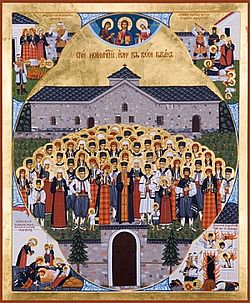 4,000–5,000 New Martyrs of Batak, Bulgaria.
 New Hieromartyr Dimitry (Lyubimov), Archbishop of Gdov.
 New Hieromartyr Protopresbyter Basil Martysz of Teratyn.
 Icon of the Mother of God "Staro Rus" (Staraya Russa).
.jpg)


.JPG)


.jpg)


Notes
- The notation Old Style or (OS) is sometimes used to indicate a date in the Julian Calendar (which is used by churches on the "Old Calendar").
The notation New Style or (NS), indicates a date in the Revised Julian calendar (which is used by churches on the "New Calendar"). - See: (in Romanian) Mavra de pe Ceahlău. Wikipedia. (Romanian Wikipedia).
- The Bulgarian Orthodox Church glorified the Batak martyrs in April 2011.
- See: (in Russian) Димитрий (Любимов). Википедии. (Russian Wikipedia).
- See: (in Polish) Bazyli Martysz. (Polish Wikipedia).
- See: (in Russian) Старорусская икона Божией Матери. Википедии. (Russian Wikipedia).