May 9 (Eastern Orthodox liturgics)
Day in the Eastern Orthodox liturgical calendar
From Wikipedia, the free encyclopedia
May 8 – Eastern Orthodox Church calendar – May 10

All fixed commemorations below celebrated on May 22 by Orthodox Churches on the Old Calendar.[note 1]
For May 9th, Orthodox Churches on the Old Calendar commemorate the Saints listed on April 26.
Saints
Pre-Schism Western saints
- Saint Beatus, Apostle of Switzerland (2nd century)[15][note 3]
- Martyr Epimachus of Pelusium, at Alexandria (250)[1][16]
- Martyr Gordion, at Rome (362)[1][16]
- Saint John of Châlon, third Bishop of Châlon-sur-Saône in France (c. 475)[15]
- Saint Gerontius, bishop of Cervia near Ravenna in Italy, martyr (c. 501)[15][17]
- Saint Sanctan, Bishop of Kill-da-Les and Kill-na-Sanctan near Dublin in Ireland (6th century)[15][18]
- Blessed Adalgar, third archbishop of Hamburg-Bremen (909)[19][20]
- Saint Vincent, Abbot of St Peter de Montes in Spain (es), a disciple and successor of St. Gennadius of Astorga (c. 950)[15]
- Saint Gregory, Bishop of Ostia (c. 1044)[15]
Post-Schism Orthodox saints
- Saint Dmitry Donskoy, Prince of Moscow (1389)[21] (see also: May 19)
- Saint Joseph (Litovkin) of Optina, Hiero-schema-monk of Optina Monastery (1911)[1][22][23][note 4][note 5]
- Venerable Elder Ieronymos of Simonopetra (1957)[25][note 6][note 7][note 8] (see also: April 26 - OS)
New martyrs and confessors
Other commemorations
- Translation of the Relics of Saint Nicholas from Myra to Bari (1087)[1][12] (see also: May 20)
- Zaraysk Icon of St. Nicholas the Wonderworker (1225)[30][35]
- Translation of the relics (1775) of Child-martyr Gabriel of Slutsk (1690)[1][30]
Icon gallery
 Prophet Isaiah.
 Great-martyr Christopher of Lycia.
 St. Aquilina.
 Saint Shio of Mgvime, monk, of Georgia.
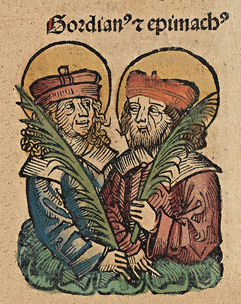 Sts. Gordianus and Epimachus (Illustration from the Nuremberg Chronicle).
 Martyrdom of St. Gordianus.
 St. Dmitry Donskoy.
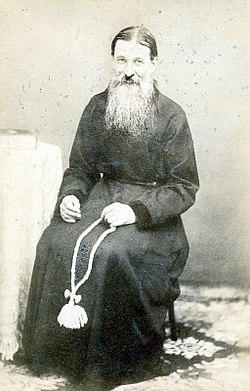 St. Joseph (Litovkin) of Optina.
 New Hieromartyr Dimitry Voskresensky.
 Reliquary of Child-martyr Gabriel of Slutsk, in the Cathedral of Białystok.

.jpg)


Notes
- The notation Old Style or (OS) is sometimes used to indicate a date in the Julian Calendar (which is used by churches on the "Old Calendar").
The notation New Style or (NS), indicates a date in the Revised Julian calendar (which is used by churches on the "New Calendar"). - A Ukrainian, St Joseph was a holy Elder in the tradition of St Paisius Velichkovsky (as were the other 13 glorified holy Elders). The Optina Monastery is, in fact, a spiritual fruit of the Ukrainian Paisian spiritual heritage. There are 16 New Venerable Martyrs of Optina of the Soviet era, among whom are also Ukrainians.[24]
- See: (in Russian) Иосиф Оптинский. Википедии. (Russian Wikipedia).
- On October 20, 2019, at the Protaton Church in Karyes on Mt. Athos, Ecumenical Patriarch Bartholomew announced the glorification of four great 20th-century Athonite elders would soon proceed, including:
- Daniel of Katounakia (†1929)
- Ieronymos of Simonopetra (†1957)
- Joseph the Hesychast (†1959), and
- Ephraim of Katounakia (†1998).[26][27]
- (in Greek) "Εἰδικώτερον, ἡ Ἁγία καί Ἱερά Σύνοδος, ἀποδεχθεῖσα εἰσήγησιν τῆς Κανονικῆς Ἐπιτροπῆς ἀνέγραψεν εἰς τό Ἁγιολόγιον τῆς Ὀρθοδόξου Ἐκκλησίας τούς ἐγνωσμένης ὁσιακῆς βιοτῆς καί πολιτείας Ἱερομόναχον Ἱερώνυμον Σιμωνοπετρίτην, Καθηγούμενον χρηματίσαντα τῆς ἐν Ἁγίῳ Ὄρει Ἱερᾶς Βασιλικῆς, Πατριαρχικῆς καί Σταυροπηγιακῆς Μονῆς Σίμωνος Πέτρας, καί ἀκολούθως Οἰκονόμον καί Πνευματικόν τοῦ Μετοχίου Ἀναλήψεως Βύρωνος Ἀττικῆς, καί Ἀρχιμανδρίτην Σωφρόνιον Σαχάρωφ, Καθηγούμενον χρηματίσαντα καί κτίτορα τῆς ἐν Ἔσσεξ Ἀγγλίας Ἱερᾶς Πατριαρχικῆς καί Σταυροπηγιακῆς Μονῆς Τιμίου Προδρόμου."[28]
- On April 20, 1920, the Sunday of the Holy Myrrhbearers, he was enthroned as the Abbot of the Monastery of his repentance (Simonopetra).
On June 15, 1931, he was exiled to the Monastery of Koutloumousiou and in three months he was sent to the "Metochion" ("Dependency") of Simonopetra in Athens, named after the Holy Ascension of Christ.
In 1937 he was re-elected Abbot of Simonopetra, but he declined this, and he remained at Holy Ascension for twenty more years, until he reposed on January 7th 1957 (the feast of Christmas on the Old Calendar).
Therefore, he lived 17 years in his homeland of Asia Minor, 43 years in the Monastery of Simonopetra and 26 years at Holy Ascension in Athens.[29] - See: (in Greek) Όσιος Ιερώνυμος Σιμωνοπετρίτης ο Μικρασιάτης. Βικιπαίδεια. (Greek Wikipedia).
- See: (in Russian) Воскресенский, Дмитрий Васильевич. Википедии. (Russian Wikipedia).
- See: Drvar uprising.