Measurable space
Basic object in measure theory; set and a sigma-algebra
From Wikipedia, the free encyclopedia
In mathematics, a measurable space or Borel space[1] is a basic object in measure theory. It consists of a set and a σ-algebra, which defines the subsets that will be measured.
It captures and generalises intuitive notions such as length, area, and volume with a set of 'points' in the space, but regions of the space are the elements of the σ-algebra, since the intuitive measures are not usually defined for points. The algebra also captures the relationships that might be expected of regions: that a region can be defined as an intersection of other regions, a union of other regions, or the space with the exception of another region.

Definition
Consider a set and a σ-algebra on Then the tuple is called a measurable space.[2] The elements of are called measurable sets within the measurable space.


Note that in contrast to a measure space, no measure is needed for a measurable space.
Example
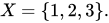
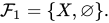
Look at the set: One possible -algebra would be: Then is a measurable space. Another possible -algebra would be the power set on : With this, a second measurable space on the set is given by



Common measurable spaces
If is finite or countably infinite, the -algebra is most often the power set on so This leads to the measurable space


If is a topological space, the -algebra is most commonly the Borel -algebra so This leads to the measurable space that is common for all topological spaces such as the real numbers


Ambiguity with Borel spaces
The term Borel space is used for different types of measurable spaces. It can refer to
- any measurable space, so it is a synonym for a measurable space as defined above [1]
- a measurable space that is Borel isomorphic to a measurable subset of the real numbers (again with the Borel -algebra)[3]
 ...
...| Families of sets over | ||||||||||
|---|---|---|---|---|---|---|---|---|---|---|
| Is necessarily true of or, is closed under: | Directed by | F.I.P. | ||||||||
| π-system |  | |  | | | | | | |
|
| Semiring | | | | | | | | | | Never |
| Semialgebra (semifield) | | | | | | | | | | Never |
| Monotone class | | | | | | only if | only if | | |
|
| 𝜆-system (Dynkin system) | | | | only if | | | only if or they are disjoint | | | Never |
| Ring (order theory) | | | | | | | | | |
|
| Ring (measure theory) | | | | | | | | | | Never |
| δ-ring | | | | | | | | | | Never |
| 𝜎-ring | | | | | | | | | | Never |
| Algebra (field) | | | | | | | | | | Never |
| 𝜎-algebra (𝜎-field) | | | | | | | | | | Never |
| Filter | | | | | | | | | |
|
| Proper filter | | | | Never | Never | | | | Never |
|
| Prefilter (filter base) | | | | | | | | | |
|
| Filter subbase | | | | | | | | | |
|
| Open topology | | | | | | |  (even arbitrary ) | | | Never |
| Closed topology | | | | | | (even arbitrary ) | | | | Never |
| Is necessarily true of or, is closed under: | directed downward | finite intersections | finite unions | relative complements | complements in | countable intersections | countable unions | contains | contains | Finite intersection property |
|
Additionally, a semiring is a π-system where every complement is equal to a finite disjoint union of sets in | ||||||||||








See also
- Borel set – Class of mathematical sets
- Measurable function – Kind of mathematical function
- Measure – Generalization of mass, length, area and volume
- Standard Borel space – Mathematical construction in topology
- Category of measurable spaces