Medicosma elliptica
From Wikipedia, the free encyclopedia
| Bulburin medicosma | |
|---|---|
Scientific classification  | |
| Kingdom: | Plantae |
| Clade: | Tracheophytes |
| Clade: | Angiosperms |
| Clade: | Eudicots |
| Clade: | Rosids |
| Order: | Sapindales |
| Family: | Rutaceae |
| Genus: | Medicosma |
| Species: | M. elliptica |
| Binomial name | |
| Medicosma elliptica | |
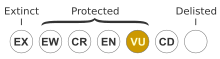
Medicosma elliptica, commonly known as Bulburin medicosma,[2] is a species of shrub or small tree in the family Rutaceae and is endemic to a restricted area of Queensland. It has elliptical leaves and white flowers borne singly or in small groups in leaf axils.
Medicosma elliptica is a shrub or tree that typically grows to a height of 7 mm (0.28 in) with glabrous branchlets. The leaves are arranged in opposite pairs, leathery, elliptical or oval, 45–125 mm (1.8–4.9 in) long and 18–60 mm (0.71–2.36 in) wide on a petiole 4–10 mm (0.16–0.39 in) long. The leaves are glabrous and have many conspicuous oil dots. The flowers are arranged singly or in small groups in leaf axils and are sessile or on a pedicel up to 1 mm (0.039 in) long. The sepals are about 2 mm (0.079 in) long and covered on the outside with soft hairs flattened against the surface. The petals are white, 4.5–5.5 mm (0.18–0.22 in) long, densely covered with flattened hairs on the back, and remain on the fruit. Flowering has been observed in April and July and the fruit is a glabrous, wrinkled follicle 7–9 mm (0.28–0.35 in) long.[2][3][4]
Taxonomy
Medicosma elliptica was first formally described in 1985 by Thomas Gordon Hartley in the Australian Journal of Botany from specimens collected in the Bulburin State Forest in 1978.[5][6]