Meiser
Arab village in northern Israel
From Wikipedia, the free encyclopedia
Meiser (Arabic: ميسر; Hebrew: מֵיסַר, also known as Shaykh Maysar or Khirbat Maysar) is an Arab village in northern Israel. Located half a kilometre west of the Green Line, north of the city of Baqa al-Gharbiyye in the triangle area of Wadi Ara, it is one of three Arab villages under the jurisdiction of Menashe Regional Council. In 2024 it had a population of 1,952.[2]
.jpg)
Meiser
| |
|---|---|
| Hebrew transcription(s) | |
| • Unofficial | Shaykh Maysar, Shaykh Maysir, Khirbat Maysar |
| |
| Etymology: Sheikh Meisir, p.n.; meaning a certain gambling game with arrows.[1] | |
  Meiser  Meiser | |
| Coordinates: 32°26′41″N 35°2′31″E | |
| Grid position | 203/705 ITM 154/205 PAL |
| Country |  Israel Israel |
| District | Haifa |
| Council | Menashe |
| Population (2024)[2] | 1,952 |
History
Roman Empire
Remains from the Early Roman era (end of the first century BCE–beginning of the first century CE) have been found here.[3][4][5] Three strata from the Roman-Byzantine periods was excavated in the centre of the village.[6] A bathhouse, dating from the same time, has also been found.[7]
Byzantine Empire
Ceramics and other remains from the Byzantine era have been found here.[4][8][9] An excavation revealed remains dating from the end of the Byzantine period (7th century CE), and above it were remains of a residential house from the Abbasid period (9th–10th centuries CE).[10]
Ottoman Empire
In 1882, the PEF's Survey of Western Palestine (SWP) found at Sheikh Meisir "foundations near a modern Mukam" (Muslim tomb).[11] In spite of this, Andrew Petersen, who inspected the Maqam in 1994, suggested "that the building may be considerably older than the nineteenth century."[12]
British Mandate
In the 1922 census of Palestine, conducted by the British Mandate authorities, Kherbet Maisir had a population of 49 Muslims.[13]
In the 1945 statistics Meiser was counted with Qaffin and Kh. el Aqaba, together they had a population of 1,570 Muslims,[14] with a land area of 23,755 dunams, according to an official land and population survey.[15] Of this, 5,863 dunams were plantations and irrigable land, 8,371 were used for cereals,[16] while 40 dunams were built-up (urban) land.[17]
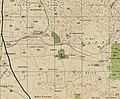 Meiser 1942 1:20,000
 Meiser 1945 1:250,000


