Merhavia (moshav)
Place in northern Israel
From Wikipedia, the free encyclopedia
Merhavia (Hebrew: מֶרְחַבְיָה, lit. "Space of God") is a moshav in northern Israel. It falls under the jurisdiction of Jezreel Valley Regional Council and in 2024 had a population of 734.[1] Founded in 1911,[dubious – discuss][citation needed] it was the first modern Jewish settlement in the Jezreel Valley.

Merhavia
| |
|---|---|
| |
  Merhavia | |
| Coordinates: 32°36′17″N 35°18′29″E | |
| Country | Israel |
| District | Northern |
| Council | Jezreel Valley |
| Affiliation | Moshavim Movement |
| Founded | 1911[dubious – discuss][citation needed] |
| Founded by | Kvutzat Kibush members and Second Aliyah immigrants |
| Population (2024)[1] | 734 |
| Website | www.merhavia.com |
Etymology
The name Merhavia is derived from the Book of Psalms 118:5.
Out of my straits I called upon the LORD; He answered me with great enlargement.
In the metaphorical sense: "God set me free" - the experience of the Jews immigrating to the Land of Israel and achieving a new homeland without the straits of persecution.
History
Co-operative
The village was established as the Co-operative in Merhavia, a co-operative farm, at the beginning of 1911, based on the ideas of Franz Oppenheimer.[2] The founders had arrived in the area in 1910 and consisted of members of Kvutzat Kibush and workers of the Second Aliyah. It was supposed to operate as a co-operative farm with differential wages, and was founded with the assistance of Arthur Ruppin, Yehoshua Hankin, the Anglo-Palestine Bank and Eliyahu Blumenfeld. Alexander Baerwald designed and built the first solid buildings and the road net with a central square in 1915.[3]
Moshav
In 1922 it was converted to a moshav ovdim[dubious – discuss] after being joined by Polish-Jewish immigrants and residents of Tel Aviv who wanted to work in agriculture.[citation needed] According to a census conducted in the same year by the British Mandate authorities, the settlement had a population of 135 Jews.[4]
In 1929 a kibbutz, also by the name of Merhavia, was established next to the moshav.[citation needed][dubious – discuss]
Gallery
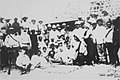 Merhavia founders 1910
 Merhavia first building 1911
 Merhavia members of Hashomer 1915
 Merhavia residents 1920
 Merhavia 1921
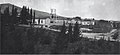 Merhavia 1929
 Merhavia 1941
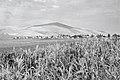 Moshav Merhavia 1947


Notable residents
- Henry Einspruch (1892–1977), a Galician-born Jew who converted to Lutheranism, becoming a Messianic missionary affiliated with the Hebrew Christian movement, best known for translating the Christian New Testament into Yiddish.