Method of continued fractions
From Wikipedia, the free encyclopedia
The method of continued fractions is a method developed specifically for solution of integral equations of quantum scattering theory like Lippmann–Schwinger equation or Faddeev equations. It was invented by Horáček and Sasakawa [1] in 1983. The goal of the method is to solve the integral equation

iteratively and to construct convergent continued fraction for the T-matrix
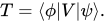
The method has two variants. In the first one (denoted as MCFV) we construct approximations of the potential energy operator in the form of separable function of rank 1, 2, 3 ... The second variant (MCFG method[2]) constructs the finite rank approximations to Green's operator. The approximations are constructed within Krylov subspace constructed from vector with action of the operator . The method can thus be understood as resummation of (in general divergent) Born series by Padé approximants. It is also closely related to Schwinger variational principle. In general the method requires similar amount of numerical work as calculation of terms of Born series, but it provides much faster convergence of the results.


The derivation of the method proceeds as follows. First we introduce rank-one (separable) approximation to the potential
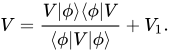
The integral equation for the rank-one part of potential is easily soluble. The full solution of the original problem can therefore be expressed as

in terms of new function . This function is solution of modified Lippmann–Schwinger equation


with The remainder potential term is transparent for incoming wave



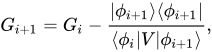
i. e. it is weaker operator than the original one. The new problem thus obtained for is of the same form as the original one and we can repeat the procedure. This leads to recurrent relations


It is possible to show that the T-matrix of the original problem can be expressed in the form of chain fraction
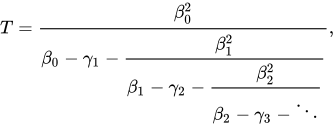
where we defined

In practical calculation the infinite chain fraction is replaced by finite one assuming that

This is equivalent to assuming that the remainder solution

is negligible. This is plausible assumption, since the remainder potential has all vectors in its null space and it can be shown that this potential converges to zero and the chain fraction converges to the exact T-matrix.