Microseris walteri
From Wikipedia, the free encyclopedia
| Microseris walteri | |
|---|---|
 | |
Scientific classification  | |
| Kingdom: | Plantae |
| Clade: | Tracheophytes |
| Clade: | Angiosperms |
| Clade: | Eudicots |
| Clade: | Asterids |
| Order: | Asterales |
| Family: | Asteraceae |
| Genus: | Microseris |
| Species: | M. walteri |
| Binomial name | |
| Microseris walteri | |
| Synonyms[2] | |
| |
Microseris walteri is an Australian perennial herb with yellow flowers and edible tuberous roots, and one of three plants known as murnong or yam daisy along with Microseris scapigera and Microseris lanceolata.[3][2]
The plant is found in southern parts of Australia, including Victoria, NSW, ACT, SA, WA and Tasmania. In Victoria, the plant is widespread and occupying a wide range of habitats, particularly dry open forest.[4]
For more than 30 years Murnong was named as Microseris sp. or Microseris lanceolata or Microseris scapigera. Royal Botanic Gardens Victoria botanist Neville Walsh clarified the botanical name of Microseris walteri in 2016 and defined the differences in the three species in the table below.[4]
| Feature | M. walteri | M. lanceolata | M. scapigera |
|---|---|---|---|
| Roots | single fleshy root expanding to a solitary, napiform to narrow-ellipsoid or narrow-ovoid, annually replaced tuber | several fleshy roots, cylindrical to long-tapered, branching just below ground-level | several cylindrical or long-tapered, usually branched shortly below leaves |
| Fruit (Capsela) | usually less than 7mm long | usually less than 7mm long | mostly 7–10 mm long |
| Pappus bristles | c. 10 mm long, 0.5–1.3mm wide at base | 10–20 mm long, c. 0.3–0.5 mm wide at base | 30–66 mm long |
| Joined petals (Ligule) | usually more than 15mm long | usually more than 15mm long | up to 12mm long |
| Origin | lowlands of temperate southern WA, SA, NSW, ACT, Victoria and Tasmania | rarely on basalt soils; alpine and subalpine NSW, ACT and Victoria | mostly from basalt plains of western Victoria and elevated sites in Tasmania |
| Taste of roots | sweet-tasting, both raw and cooked | bitter, slightly fibrous and not particularly palatable | slightly fibrous, and slightly, but tolerably bitter |
Biological descriptions
Microseris walteri has the form of a tufted rosette of toothed lanceolate leaves.
The flower appears in Spring, which is a yellow head of florets, similar to flatweed (Hypochaeris radicata) or dandelion (Taraxacum). The flower stalk is pendulous before flowering, becoming erect for flowering to attract pollinators and again with the ripening of the seed head. The seed heads ripen to a cluster of fluffy, tan achenes, each having a crown of fine extensions called a pappus. The seeds are dispersed by wind.[5]
The plant usually grows a single tuber each season. There is a wide variation in shape and size of tubers between plants from different habitats in the Victoria. Those from northwest Victoria have probably the longest tubers. A rare form from the volcanic plain (Woorndoo area) has a stocky, sometimes few-branched, but apparently perennial tap-root.[2]
Gallery
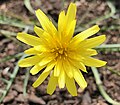 Microseris walteri flower
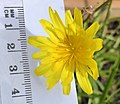 Flower measurement
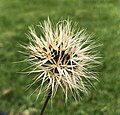 Seed clock
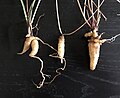 Roots
Roots Seed comparison, from left to right: Microseris scapigera, Microseris walteri and Microseris lanceolata


