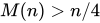
Since it was first formulated, there has been continuous progress made in the calculation of lower bounds and upper bounds of M (n), with the following results:[1][2]
| Limit inferior |
Author(s) |
Year |
|---|
 | P. Erdős | 1955 |
 | P. Erdős, Scherk | 1955 |
 | S. Swierczkowski | 1958 |
 | L. Moser | 1966 |
 | J. K. Haugland | 1996 |
 | E. P. White | 2022 |
| Limit superior |
Author(s) |
Year |
|---|
 | P. Erdős | 1955 |
 | T. S. Motzkin, K. E. Ralston and J. L. Selfridge | 1956 |
 | J. K. Haugland | 1996 |
 | J. K. Haugland | 2016 |
 | AlphaEvolve (Novikov et al.) | 2025 |
 | TTT-Discover (Yuksekgonul et al.) | 2026 |
J. K. Haugland showed that the limit of M (n) / n exists and that it is less than 0.385694. For his research, he was awarded a prize in a young scientists competition in 1993.[4] In 1996, he improved the upper bound to 0.38201 using a result of Peter Swinnerton-Dyer.[5][2] This has now been further improved to 0.38093.[6] In 2022, the lower bound was shown to be at least 0.379005 by E. P. White.[7] In 2025, the AI system AlphaEvolve improved the upper bound to 0.380924,[8] and in 2026 TTT-Discover, another AI system, further improved it to 0.380876.[9]
The values of M (n) for the first 15 positive integers are the following:[1]
 |
1 | 2 | 3 | 4 | 5 | 6 | 7 | 8 | 9 | 10 | 11 | 12 | 13 | 14 | 15 | ... |
 |
1 | 1 | 2 | 2 | 3 | 3 | 3 | 4 | 4 | 5 | 5 | 5 | 6 | 6 | 6 | ... |
It is just the Law of Small Numbers that it is 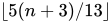 [1]
[1]
