Mittag-Leffler's theorem
Mathematical theorem in complex analysis
From Wikipedia, the free encyclopedia
In complex analysis, Mittag-Leffler's theorem concerns the existence of meromorphic functions with prescribed poles. Conversely, it can be used to express any meromorphic function as a sum of partial fractions. It is sister to the Weierstrass factorization theorem, which asserts existence of holomorphic functions with prescribed zeros.

The theorem is named after the Swedish mathematician Gösta Mittag-Leffler who published versions of the theorem in 1876 and 1884.[1][2][3]
Theorem
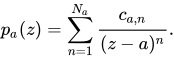
Let be an open set in and be a subset whose limit points, if any, occur on the boundary of . For each in , let be a polynomial in without constant coefficient, i.e. of the form Then there exists a meromorphic function on whose poles are precisely the elements of and such that for each such pole , the function has only a removable singularity at ; in particular, the principal part of at is . Furthermore, any other meromorphic function on with these properties can be obtained as , where is an arbitrary holomorphic function on . (Here, note that a function being analytic and holomorphic are equivalent attributes)




Proof sketch
One possible proof outline is as follows. If is finite, it suffices to take . If is not finite, consider the finite sum where is a finite subset of . While the may not converge as F approaches E, one may subtract well-chosen rational functions with poles outside of (provided by Runge's theorem) without changing the principal parts of the and in such a way that convergence is guaranteed.




Example
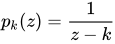
Suppose that we desire a meromorphic function with simple poles of residue 1 at all positive integers. With notation as above, letting and , Mittag-Leffler's theorem asserts the existence of a meromorphic function with principal part at for each positive integer . More constructively we can let


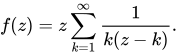
This series converges normally on any compact subset of (as can be shown using the M-test) to a meromorphic function with the desired properties.

Pole expansions of meromorphic functions
Here are some examples of pole expansions of meromorphic functions:


