Moiety conservation
From Wikipedia, the free encyclopedia
Moiety conservation is the conservation of a subgroup in a chemical species, which is cyclically transferred from one molecule to another. In biochemistry, moiety conservation can have profound effects on the system's dynamics.[1]
A typical example of a conserved moiety[2] in biochemistry is the Adenosine diphosphate (ADP) subgroup that remains unchanged when it is phosphorylated to create adenosine triphosphate (ATP) and then dephosphorylated back to ADP forming a conserved cycle. Moiety-conserved cycles in nature exhibit unique network control features which can be elucidated using techniques such as metabolic control analysis. Other examples in metabolism include NAD/NADH, NADP/NADPH, CoA/Acetyl-CoA. Conserved cycles also exist in large numbers in protein signaling networks when proteins get phosphorylated and dephosphorylated.

Most, if not all, of these cycles, are time-scale-dependent. For example, although a protein in a phosphorylation cycle is conserved during the interconversion, over a longer time scale, there will be low levels of protein synthesis and degradation, which change the level of protein moiety. The same applies to cycles involving ATP, NAD, etc. Thus, although the concept of a moiety-conserved cycle in biochemistry is a useful approximation,[3] over time scales that include significant net synthesis and degradation of the moiety, the approximation is no longer valid. When invoking the conserved-moiety assumption on a particular moiety, we are, in effect, assuming the system is closed to that moiety.

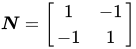
![{\displaystyle {\begin{bmatrix}{\frac {dA}{dt}}\\{\frac {dAP}{dt}}\end{bmatrix}}=\left[{\begin{array}{rr}1&-1\\-1&1\end{array}}\right]\left[{\begin{array}{r}v_{1}\\v_{2}\end{array}}\right]}](https://wikimedia.org/api/rest_v1/media/math/render/svg/2e44cbae1d6a5c26903a9e719e8b8ef0afa63019)
![{\displaystyle {\begin{aligned}{\frac {dA}{dt}}&=v_{1}-v_{2}\\[4pt]{\frac {dAP}{dt}}&=v_{2}-v_{1}\end{aligned}}}](https://wikimedia.org/api/rest_v1/media/math/render/svg/2a9c5e97fa74a13079001ddc81886bce7674dabc)




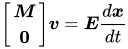

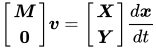


![{\displaystyle {\begin{aligned}AP&=T-A\\[4pt]{\frac {dA}{dt}}&=v_{1}-v_{2}\end{aligned}}}](https://wikimedia.org/api/rest_v1/media/math/render/svg/319b83ce4bcce06f109499eb77eddd53c368fb06)