Monitored neutrino beam
From Wikipedia, the free encyclopedia
Monitored neutrino beams are facilities for the production of neutrinos with unprecedented control of the flux of particles created inside and outside the facility.
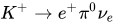
Accelerator neutrino beams are beams of neutrinos produced by particle accelerators.[1][2] Since neutrinos are neutral particles that feebly interact with matter, monitoring the production rate of neutrinos at accelerators is a major experimental challenge. M. Schwartz and B. Pontecorvo proposed to exploit accelerators to produce neutrinos in 1960.[3] Their ideas brought to the first neutrino experiment where neutrinos were produced by an accelerator from the scattering of protons in a beryllium target. The scattering produces a wealth of particles and, in particular, pions, which decay producing muons and neutrinos. The experiment, first carried out by Lederman, Schwartz, Steinberger and collaborators demonstrated the existence of two neutrino flavors.[4] At that time, protons were not even steered outside the accelerator but the target was inserted close to the proton orbit. The protons in the AGS accelerator of the Brookhaven National Laboratory were brought to strike an internal Be target in a short straight session of the accelerator. Modern experiments steer the protons outside the accelerator and focus the particles produced after the target by magnetic horns or a static focusing system based on quadrupoles and dipoles. The focusing system increases the flux of pions pointing toward the neutrino detector and selects the charge and momentum of these pions. After focusing, pions propagate along a tunnel and decay by reactions like . All undecayed pions and all muons are stopped at the end of the tunnel while the neutrinos cross the wall of the tunnel because their interaction probability is very small. At large distances from the end of the tunnel, no particles are present except for an intense flux of neutrinos.

Diagnostics and flux determination
In early experiments, the flux of neutrinos was estimated by measuring the number of pions produced after the target and monitoring the muons produced at the end of the tunnel. After the discovery of neutrino oscillation, the need for high precision beams fostered the construction of sophisticated monitoring systems. They are based on dedicated experiments to measure the number of particles produced by proton interactions on solid-state targets (beryllium, graphite). The beamline comprises the proton beam, target, focusing system, and decay tunnel, and it is simulated by Monte Carlo methods. Variations of the flux are monitored in real-time by measuring the number of protons impinging on the target and the rate of muons. All these techniques are the basic toolkit of accelerator neutrino physicists and are inherited by beam diagnostics.[5]