Monogenic system
From Wikipedia, the free encyclopedia
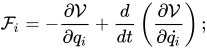
In classical mechanics, a physical system is termed a monogenic system if the force acting on the system can be modelled in a particular, especially convenient mathematical form. The systems that are typically studied in physics are monogenic. The term was introduced by Cornelius Lanczos in his book The Variational Principles of Mechanics (1970).[1][2]
In Lagrangian mechanics, the property of being monogenic is a necessary condition for certain different formulations to be mathematically equivalent. If a physical system is both a holonomic system and a monogenic system, then it is possible to derive Lagrange's equations from d'Alembert's principle; it is also possible to derive Lagrange's equations from Hamilton's principle.[3]