Moritz Bergstein Shoddy Mill and Warehouse
From Wikipedia, the free encyclopedia
Moritz Bergstein Shoddy Mill and Warehouse | |
 The Moritz Bergstein Shoddy Mill and Warehouse from the west | |
   | |
| Location | 805 South Main Street, Stillwater, Minnesota |
|---|---|
| Coordinates | 45°3′4.8″N 92°48′4.7″W / 45.051333°N 92.801306°W |
| Area | less than one acre |
| Built | c. 1890 |
| NRHP reference No. | 08000133[1] |
| Added to NRHP | March 5, 2008 |
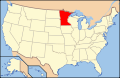
The Moritz Bergstein Shoddy Mill and Warehouse are two historic industrial buildings in Stillwater, Minnesota, United States, in which Jewish German immigrant Moritz Bergstein conducted a recycling business circa 1890 to 1910 providing materials for mattresses. They were originally built in Oak Park Heights, Minnesota, around 1890 and were moved to neighboring Stillwater in 2012 to make way for construction of the St. Croix Crossing bridge.[2] The property was listed on the National Register of Historic Places in 2008 for its local significance in the themes of industry and social history.[3] It was nominated as a rare surviving embodiment of Minnesota's early Jewish immigrants and their frequent participation in the waste materials trade.[4]
The owners, Moritz and Bertha Bergstein, settled in Oak Park Heights (then known as Oak Park) in 1890. They were in the business of recycling waste material. The shoddy mill, a rubble stone building, was used to recycle waste fabric into material to stuff mattresses.[5]
Moritz Bergstein was known as the "junk man" in Stillwater, and in addition to making mattresses he also operated a salvage business.[6] He recycled waste paper, rags, scrap metal, and wood shavings, and he built a machine that tore up the rags. He employed several women to fabricate the mattresses. Later Bergstein entered into a partnership with his brother, Ignatz, to form a mattress-making firm. Although Moritz eventually discontinued making mattresses in Oak Park Heights, he continued to buy and sell waste materials, mostly scrap metal. When he died in 1923 he left behind "about 500 tons of iron and old junk", valued at about $3000. The Stillwater Daily Gazette called him "one of the best known men in Stillwater" and noted that he was "always honest and straight forward in his dealings."[7]
There were few Jewish settlers in Minnesota in its pioneer days, so the story of the Bergsteins provides insight into early Jewish life in Minnesota.[6] The Bergsteins emigrated from Europe in 1880, during a time when many Jews were emigrating from eastern Europe, but Moritz was born in Germany and Bertha was born in Bohemia. While many Jewish immigrants dealt in used goods and recycled materials, the Bergsteins were atypical because they lived in a town distant from other Jews, engaged in light manufacturing, owned property soon after they moved to Minnesota, and hired non-Jewish workers.[8]