For one-dimensional signals, there exists quite a well-developed theory for continuous and discrete kernels that guarantee that new local extrema or zero-crossings cannot be created by a convolution operation.[1] For continuous signals, it holds that all scale-space kernels can be decomposed into the following sets of primitive smoothing kernels:
- the Gaussian kernel :
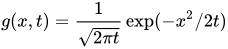 where
where  ,
,
- truncated exponential kernels (filters with one real pole in the s-plane):
 if
if  and 0 otherwise where
 if
if  and 0 otherwise where
  ,
,
- translations,
- rescalings.
For discrete signals, we can, up to trivial translations and rescalings, decompose any discrete scale-space kernel into the following primitive operations:
- the discrete Gaussian kernel
 where
where  where
where  are the modified Bessel functions of integer order,
- generalized binomial kernels corresponding to linear smoothing of the form
 where
where 
 where ,
- first-order recursive filters corresponding to linear smoothing of the form
 where
where 
 where
where  ,
,
- the one-sided Poisson kernel
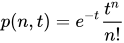 for
for  where
where 
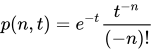 for
for  where .
From this classification, it is apparent that we require a continuous semi-group structure, there are only three classes of scale-space kernels with a continuous scale parameter; the Gaussian kernel which forms the scale-space of continuous signals, the discrete Gaussian kernel which forms the scale-space of discrete signals and the time-causal Poisson kernel that forms a temporal scale-space over discrete time. If we on the other hand sacrifice the continuous semi-group structure, there are more options:
For discrete signals, the use of generalized binomial kernels provides a formal basis for defining the smoothing operation in a pyramid. For temporal data, the one-sided truncated exponential kernels and the first-order recursive filters provide a way to define time-causal scale-spaces [2][3] that allow for efficient numerical implementation and respect causality over time without access to the future. The first-order recursive filters also provide a framework for defining recursive approximations to the Gaussian kernel that in a weaker sense preserve some of the scale-space properties.[4][5]