Multisymplectic integrator
From Wikipedia, the free encyclopedia
In mathematics, a multisymplectic integrator is a numerical method for the solution of a certain class of partial differential equations, that are said to be multisymplectic. Multisymplectic integrators are geometric integrators, meaning that they preserve the geometry of the problems; in particular, the numerical method preserves energy and momentum in some sense, similar to the partial differential equation itself. Examples of multisymplectic integrators include the Euler box scheme and the Preissman box scheme.
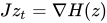
A partial differential equation (PDE) is said to be a multisymplectic equation if it can be written in the form where is the unknown, and are (constant) skew-symmetric matrices and denotes the gradient of .[1] This is a natural generalization of , the form of a Hamiltonian ODE.[2]



Examples of multisymplectic PDEs include the nonlinear Klein–Gordon equation , or more generally the nonlinear wave equation ,[3] and the KdV equation .[4]



Define the 2-forms and by where denotes the dot product. The differential equation preserves symplecticity in the sense that[5][6] Taking the dot product of the PDE with yields the local conservation law for energy:[7] where The local conservation law for momentum is derived similarly:[7] where







![{\displaystyle {\begin{aligned}E(u)&=S(u)-{\tfrac {1}{2}}\kappa (u_{x},u),\\[1ex]F(u)&={\tfrac {1}{2}}\kappa (u_{t},u).\end{aligned}}}](https://wikimedia.org/api/rest_v1/media/math/render/svg/2f048ef958377761685aadc3c0b39ba05746bd6b)

![{\displaystyle {\begin{aligned}I(u)&={\tfrac {1}{2}}\omega (u_{x},u),\\[1ex]G(u)&=S(u)-{\tfrac {1}{2}}\omega (u_{t},u).\end{aligned}}}](https://wikimedia.org/api/rest_v1/media/math/render/svg/15d5555e1dbc7ab75c5c19a80bcbb4d0c184806c)
The Euler box scheme
A multisymplectic integrator is a numerical method for solving multisymplectic PDEs whose numerical solution conserves a discrete form of symplecticity.[8] One example is the Euler box scheme, which is derived by applying the symplectic Euler method to each independent variable.[9]
The Euler box scheme uses a splitting of the skew-symmetric matrices and of the form: For instance, one can take and to be the upper triangular part of and , respectively.[10]


Now introduce a uniform grid and let denote the approximation to where and are the grid spacing in the time- and space-direction. Then the Euler box scheme is where the finite difference operators are defined by[11] The Euler box scheme is a first-order method,[9] which satisfies the discrete conservation law[12] where



![{\displaystyle {\begin{aligned}\partial _{t}^{+}u_{n,i}&={\frac {u_{n+1,i}-u_{n,i}}{\Delta {t}}},&\partial _{x}^{+}u_{n,i}&={\frac {u_{n,i+1}-u_{n,i}}{\Delta {x}}},\\[1ex]\partial _{t}^{-}u_{n,i}&={\frac {u_{n,i}-u_{n-1,i}}{\Delta {t}}},&\partial _{x}^{-}u_{n,i}&={\frac {u_{n,i}-u_{n,i-1}}{\Delta {x}}}.\end{aligned}}}](https://wikimedia.org/api/rest_v1/media/math/render/svg/cf99b69e6bf1dacdc6857b7cd2c031a2952795c3)

![{\displaystyle {\begin{aligned}\omega _{n,i}&=\mathrm {d} u_{n,i-1}\wedge K_{+}\,\mathrm {d} u_{n,i}\\[1ex]\kappa _{n,i}&=\mathrm {d} u_{n-1,i}\wedge L_{+}\,\mathrm {d} u_{n,i}.\end{aligned}}}](https://wikimedia.org/api/rest_v1/media/math/render/svg/aff789bc19ff4a4ad4eb4a59536f58e8531a61c9)



![{\displaystyle {\begin{aligned}u_{n,i+1/2}&={\frac {u_{n,i}+u_{n,i+1}}{2}},\\[1ex]u_{n+1/2,i}&={\frac {u_{n,i}+u_{n+1,i}}{2}},\\[1ex]u_{n+1/2,i+1/2}&={\frac {u_{n,i}+u_{n,i+1}+u_{n+1,i}+u_{n+1,i+1}}{4}}.\end{aligned}}}](https://wikimedia.org/api/rest_v1/media/math/render/svg/ab4e634104ed481707d0161bdbfb8ae206cce52b)
![{\displaystyle {\begin{aligned}\omega _{n,i}&=\mathrm {d} u_{n,i+1/2}\wedge K\,\mathrm {d} u_{n,i+1/2}\\[1ex]\kappa _{n,i}&=\mathrm {d} u_{n+1/2,i}\wedge L\,\mathrm {d} u_{n+1/2,i}.\end{aligned}}}](https://wikimedia.org/api/rest_v1/media/math/render/svg/c6d03c8fc57e029cf1afb0381622c9e729df76a8)