Mumrills
Roman fort site in Scotland
From Wikipedia, the free encyclopedia
Mumrills was the site of the largest Roman fort on the Antonine Wall in Scotland.[1] It is possible that Mumrills could exchange signals with Flavian Gask Ridge forts.[2] Some believe Mumrills may have been the site of Wallace's defeat at the Battle of Falkirk.[3] The farm at Mumrills was also used as an early site for the Falkirk Relief Church.[4]

Excavations
Inscribed Stones
An altar to Hercules Magusanus[8] was found in 1841 "near the Bridge at Brightons" about a mile south-east of this fort. It is now in the National Museums Scotland.[9]
A second altar to the Matres (mother goddesses) was found at Mumrills. The altar was dedicated by Cassius, a signifer serving at the fort. The historian Alfred von Domaszewski had suggested that the "Matres" mentioned in the altar were actually the Campestres, another term for the Silvanae.[10] It was carved between 140 and 165 AD.[11]
A third inscribed stone has been described as a "Funerary inscription for Nectovelius". George Macdonald says the translation is: "To the Divine Manes. Nectovelius, son of Vindex. Aged thirty. A Brigantian by birth, he served for nine years in the Second Cohort of Thracians."[12] The Brigantes were a Celtic tribe who controlled the largest section of what would become Northern England. This shows local recruitment of native Britons.
Other Finds and Videos of Scans
A stone carving of Hercules was found in a back garden in the village of Laurieston, Falkirk in 1987.[13]
Other finds include a section of a palmate funerary monument,[14] a heavy, iron chisel,[15] a set of wrought iron tongs,[16] a box flue tile,[17] a cooking pot of back burnished ware,[18] and a large piece of Roman concrete made out of crushed tile.[19]
Many Roman forts along the wall held garrisons of around 500 men.[20] Larger forts like Castlecary and Birrens had a nominal cohort of 1000 men[21] but probably sheltered women and children[22] as well although the troops were not allowed to marry.[23] There is likely too to have been large communities of civilians around the site.[24] Something of the soldiers' diet may be inferred from the variety of animal bones and shells found at the fort.[25] Other buildings have been found which might have supported smelly industries like tanning or smithing. A hearth was found which could have been used to support troops.[26]
Gallery

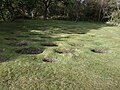 There is evidence to show that Mumrills had lilia pits like those that can still be seen at Roughcastle.[29]
 RIB 2140. Altar dedicated to Hercules Magusanus. George MacDonald calls in no. 33 in the 2nd edition of his book The Roman Wall in Scotland.[30]
 RIB 2142. Funerary inscription for Nectovelius. George MacDonald calls in no. 55 in the 2nd edition of his book The Roman Wall in Scotland.[31]
 Sketch plan of kiln at Mumrills, by Mungo Buchanan from the Proceedings Of The Society Of Antiquaries Of Scotland[32] (1914-1915) Vol 49
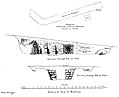 Details of kiln at Mumrills


