Munisuvrata
20th Tirthankara of Jainism, in current cycle of Jain cosmology
From Wikipedia, the free encyclopedia
Munisuvrata or Munisuvratanatha (IAST: Munisuvratanātha) (Devanagari: मुनिसुव्रतनाथ) (Sanskrit: मुनिसुव्रतः) was the twentieth Tirthankara of the present half time cycle (avasarpini) in Jain cosmology. He became a siddha, a liberated soul which has destroyed all of his karma. Events of the Jaina version of Ramayana are placed at the time of Munisuvrata. Munisuvrata lived for over 30,000 years. His chief apostle (gaṇadhara) was sage Malli Svāmi.

| Munisuvrata | |
|---|---|
20th Tirthankara | |
| Member of Tirthankara, Shalakapurusha, Arihant and Siddha | |
12th Century Idol of Munisuvrata at Samdi Vihara Temple, Bharuch, Gujarat | |
| Venerated in | Jainism |
| Predecessor | Mallinatha |
| Successor | Naminatha |
| Symbol | Tortoise[1] |
| Height | 20 dhanusha |
| Age | 30,000 |
| Color | Black |
| Gender | Male |
| Genealogy | |
| Born | |
| Died | |
| Parents |
|
| Dynasty | Harivaṁśa |
Legends
Munisuvrata was the twentieth tirthankara of the present half time cycle (avasarpini) in Jain cosmology.[2] Jain texts like padmapurana place him as a contemporary of Rama.[3][4] According to Jain texts, Munisuvrata was born as 54 lakh years passed after the birth of the nineteenth tirthankara, Mallinātha.[5][6] According to Jain beliefs, Munisuvrata descended from the heaven called Ānata kalpa on the twelfth day of the bright half of the month of Āśvina – āśvina śukla dvādaśi– to queen Padmavati and king Sumitra.[7][8] On the third day of Shraavana (month) Krishna (dark fortnight) according to Hindu calendar, queen Padmavati of Rajgir saw fourteen auspicious dreams. When she shared her dreams with her husband, king Sumitra of the Harivamsa clan, he explained that a tirthankara will be born to them soon. Then, Munisuvrata was born to them on the fifteenth day of the Shraavana Shukla (bright fortnight) in 1,184,980 BC.[2][9] His height is mentioned to be 20 dhanusha (60 metres) and complexion as a dark one.[7][10][6]
According to Jain texts, after spending 7,500 years as a youth, Munisuvrata is believed to have ruled his kingdom for 15,000 years (rājyakāla). He then renounced all worldly pursuits and became a monk. According to Jain beliefs, he spent 11 months performing karma-destroying austerities and then attained the all-embracing knowledge – Omniscience (kevala jñāna) under a Champaka tree.[11][7] He is said to have 18 ganadharas headed by Malli. Puspavati or Puspadatta is believed to be the head-nun of his order.[7] Samayavayanga sutra, however, names Kumbha and Amila as the head ganadhara and head nun respectively.[7]
Munisuvrata is said to have lived for over 30,000 years and attained liberation (nirvāña) from Sammeda śikhara on the twelfth day of the dark half of the month of phālguna – phālguna kṛṣna dvādaśi.[7][11][6] Varuna is mentioned to be his yaksha and his yakhsini is named Bahurupini in Digambara tradition and Naradatta in Śvetāmbara tradition.[7]
Munisuvrata's successor, Naminatha, is said to have been born 9 lakh years after him.[6]
Munisuvrata finds mentions in Jain texts like Uttarapurana and Tiloyapannati.[7]
Adoration
Svayambhustotra by Acharya Samantabhadra is the adoration of twenty-four tirthankaras. Its five slokas (aphorisms) adore the qualities of Munisuvrata.[12]
O Lord Munisuvratanātha! You had attained the excellent observance of the vows of the sages; you are the ascetic supreme, and utterly pristine (having destroyed the inimical karmas). You stood out in the assembly of the sages like the moon in the midst of the constellations of stars.
— Svayambhūstotra (20-1-111)[13]
An idol of Munisuvrata was installed in 127 AD or 157 AD in the Devanirmita stupa, Mathura.[7]
Iconography
Munisuvrata is usually depicted in a sitting (or standing) meditative pose, with a tortoise symbol beneath him;[14] each tīrthankara has a distinct emblem, which allows worshippers to distinguish similar idols.[15] Jivantasvami represents Munisuvrata as a princely state. The Jina is represented as standing in the kayotsarga pose wearing crown and ornaments.[16]
Colossal statues
- Statue of Purity is a 151 feet (46 m) statue dedicated to Munisuvrata under construction in Bhora Kalan, Haryana.[17]
- A 54 feet (16 m) black stone statue of Munisuvrata was installed in Jainaragutti near Adagur in the state of Karnataka.[18]
- A 27 feet (8.2 m) idolf of Munisuvrata is installed near the Shantinath Jain Teerth, Maharashtra.
 State Museum Bhopal, 6th century
 Idol of Munisuvrat at Aagashi Jain Temple, Virar, Maharashtra
 12th Century (1153 AD), hasteda, Rajasthan
 Munisuvrata, 1466 CE, Western India, National Museum, New Delhi


Main Temples

Due to his status as the 20th tirthankara, Munisuvrata is widely venerated across the Indian subcontinent, with several historically and architecturally significant temples dedicated to him.[19] In Karnataka, the Chaturmukha Basadi in Karkala stands out as a renowned late 16th-century stone temple.[20][21] Built in 1586 CE, it is celebrated for its completely symmetrical, four-faced (chaturmukha) architecture, housing life-size idols of the tirthankaras Aranatha, Mallinatha, and Munisuvrata facing all four cardinal directions.[20] Further north, the Paithan Jain Tirth in Maharashtra serves as an ancient and highly revered Digambara pilgrimage center on the banks of the Godavari River.[22] Its primary deity is a venerated black stone idol of Munisuvrata that is heavily associated with miracles in regional Jain folklore.[22] Additionally, the ancient underground Keshoraipatan Jain temple in Rajasthan acts as another major regional pilgrimage site for the Digambara sect, alongside other notable shrines like the Shri Munisuvrata Nemi Parshva Jinalaya in Santhu.[1]
Continuing the ancient Jain tradition of erecting massive monolithic monuments, Munisuvrata has also been the subject of several prominent modern structural tributes.[23] A massive 54-foot (16 m) monolithic black stone statue of Munisuvrata, depicted in the standing meditation posture (kayotsarga), is installed at Jainaragutti near Adagur in Karnataka.[24] Furthermore, a colossal 151-foot (46 m) monument known as the Statue of Purity is currently under construction in Bhora Kalan, Haryana. Upon its completion, it is slated to be one of the tallest modern Jain monuments in northern India.
- Shri 1008 Munisuvratnath Digambar Jain Atishay Kshetra SwastiDham
- Shantinath Jain Teerth, Indapur
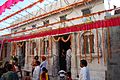 Shri Munisuvrata-Nemi-Parshva Jinalaya at Santhu
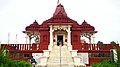 Naulakha Mandir, Rajgir
 Hasteda, Jain temple


.jpg)
See also

