NGC 1491
Emission nebula in the constellation Perseus
From Wikipedia, the free encyclopedia
NGC 1491, also known as LBN 704, SH2-206 or the Fossil Footprint Nebula, is an emission type bright nebula located about 9,800 light years away from Earth in the constellation of Perseus.[1] It was discovered on 23 December 1790 by William Herschel.

| Emission nebula | |
|---|---|
 The nebula NGC 1491 | |
| Observation data: J2000 epoch | |
| Subtype | H II region |
| Right ascension | 04h 03m 15.9s[1] |
| Declination | +51° 18′ 54″[1] |
| Distance | 3.02 ± 0.6 kpc (9,800 ± 2,000 ly)[1] ly |
| Apparent dimensions (V) | ~1½° [2] |
| Constellation | Perseus |
| Designations | Ced 25, LBN 704, LBN 706, Sharpless 2-206,[1] Little Pacman Nebula [3] |
The nebula gets its deep red coloration due to many massive stars (such as BD+50 866) embedded within NGC 1491 producing large amounts of ultraviolet radiation and ionizing the hydrogen gas that makes up the nebula.[4][5]
Gallery
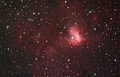 NGC 1491 from the Mount Lemmon Sky Center
 Closeup of NGC 1491 - Peter Kennett


