NGC 3156
Galaxy in the constellation Sextans
From Wikipedia, the free encyclopedia
NGC 3156 is a lenticular galaxy located in the constellation Sextans.[5][6][7] It is located at a distance of about 75 million light-years from Earth and is forming a pair with NGC 3169. It was discovered by astronomer William Herschel on December 13, 1784.[8]
.jpg)
Right ascension10h 12m 41.24591s[1]
Declination+03° 07′ 45.6939″[1]
| NGC 3156 | |
|---|---|
NGC 3156 by Hubble Space Telescope | |
| Observation data (J2000 epoch) | |
| Constellation | Sextans |
| Right ascension | 10h 12m 41.24591s[1] |
| Declination | +03° 07′ 45.6939″[1] |
| Redshift | 0.00415[2] |
| Heliocentric radial velocity | 1242 km/s[2] |
| Distance | 72.67 ± 0.46 Mly (22.28 ± 0.14 Mpc)[3] |
| Apparent magnitude (V) | 12.30[4] |
| Apparent magnitude (B) | 13.07[4] |
| Characteristics | |
| Type | S0[4] |
| Other designations | |
| UGC 5503, MCG +01-26-019, PGC 29730[2] | |
It is a member of the NGC 3166 Group of galaxies, which is a member of the Leo II Groups, a series of galaxies and galaxy clusters strung out from the right edge of the Virgo Supercluster.[9][10]
Gallery
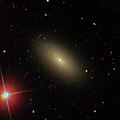 NGC 3156 (SDSS DR14)


.jpg)