NGC 4571
Galaxy in the constellation Coma Berenices
From Wikipedia, the free encyclopedia
NGC 4571 is a spiral galaxy located in the constellation of Coma Berenices. It was discovered by German-British astronomer William Herschel on 14 January 1787.[2] It was also observed by German astronomer Friedrich Schwassmann on 23 November 1900, causing it to be listed in the Index Catalogue as IC 3588.[2] John Dreyer thought this galaxy might be the "lost" Messier 91, but in 1969, amateur astronomer William C. Williams realized that M91 was actually NGC 4548.[3]
.jpg)
| NGC 4571 | |
|---|---|
NGC 4571 imaged by the Hubble Space Telescope | |
| Observation data (J2000 epoch) | |
| Constellation | Coma Berenices |
| Right ascension | 12h 36m 56.3959s[1] |
| Declination | +14° 13′ 02.627″[1] |
| Redshift | 0.001107±0.0000118[1] |
| Heliocentric radial velocity | 332±4 km/s[1] |
| Distance | 52.59 ± 1.66 Mly (16.124 ± 0.508 Mpc)[1] |
| Apparent magnitude (V) | 11.8[1] |
| Characteristics | |
| Type | SA(r)d[1] |
| Size | ~71,600 ly (21.96 kpc) (estimated)[1] |
| Apparent size (V) | 3.6′ × 3.2′[1] |
| Other designations | |
| VCC 1696, IRAS 12344+1429, IC 3588, UGC 7788, MCG +02-32-156, PGC 42100, CGCG 070-194[1] | |
Physical properties
The finding of Cepheids by the Canada France Hawaii Telescope in 1994 has established that this galaxy is a member of the Virgo Cluster.[3]
Despite being classified as a late-type galaxy, NGC 4571 has features more typical of spiral galaxies of earlier Hubble type such as a high color index, both low star formation rate and H-Alpha brightness, and relatively little neutral hydrogen,[4] suggesting it may have lost most of its gas due to interactions with Virgo's intragalactic medium and/or past interactions with other galaxies of the cluster.[5][6][7]
The low-surface brightness galaxy Malin 1 is located close to this object.[8] It is totally unrelated, however as it lies at a much higher distance.
Gallery
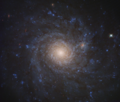 NGC 4571 imaged by the Hubble Space Telescope
 NGC 4571 by Hubble Space Telescope
 NGC 4571 (SDSS DR14)


