NGC 4866
Galaxy in the constellation Virgo
From Wikipedia, the free encyclopedia
NGC 4866 is an unbarred lenticular galaxy[5] located roughly 100 million light-years[3] away in the constellation Virgo. It was first observed by British astronomer Sir William Herschel on January 14, 1787.[6] It is a member of the Virgo Cluster.[7]

| NGC 4866 | |
|---|---|
HST image of NGC 4866 | |
| Observation data (J2000 epoch) | |
| Constellation | Virgo |
| Right ascension | 12h 59m 27.140s[1] |
| Declination | +14° 10′ 15.78″[1] |
| Redshift | 0.006615[2] |
| Heliocentric radial velocity | 1977 km/s[2] |
| Distance | 101.27 ± 0.65 Mly (31.05 ± 0.20 Mpc)[3] |
| Group or cluster | Virgo Cluster |
| Apparent magnitude (V) | 11.08[4] |
| Apparent magnitude (B) | 12.00[4] |
| Characteristics | |
| Type | SA0+(r):[5] |
| Apparent size (V) | 5.8′ × 0.95′[6] |
| Other designations | |
| UGC 8102, MCG +02-33-045, PGC 44600[2] | |
On April 1, 2015, a bright source was discovered by the All Sky Automated Survey for SuperNovae (ASAS-SN) program, and was designated ASASSN-15ga. The source is likely a type Ia supernova.[8]
Gallery
 NGC 4866 by Hubble Space Telescope
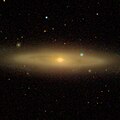 NGC 4866 by the Sloan Digital Sky Survey
 NGC 4866 (HST)


.jpg)